
Digital habits continue to evolve at a rapid pace. According to eMarketer‘s Time Spent with Connected Devices 2025 report, this year adults in the US will spend an average of 8 hours and 36 minutes per day on digital consumption, which is equivalent to two-thirds of their total media time and represents a year-on-year growth of 3%. The digitization of everyday life shows no signs of slowing down.
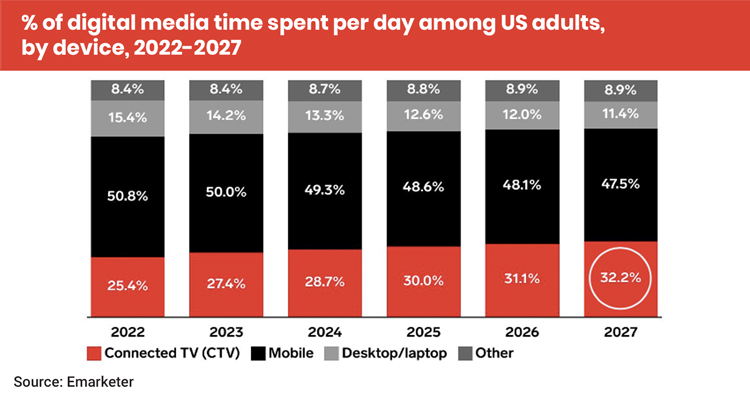
In 2025, digital consumption will move at the pace of video, apps, and artificial intelligence, and the competition for users’ attention will no longer be played out on a single device, but in a fragmented ecosystem where each screen fulfills a specific function. Although the mobile phone remains the most widely used device, its share falls slightly from 49.3% to 48.6% of digital time, while connected TV (CTV) gains ground, accounting for 30% and showing the highest growth projection.
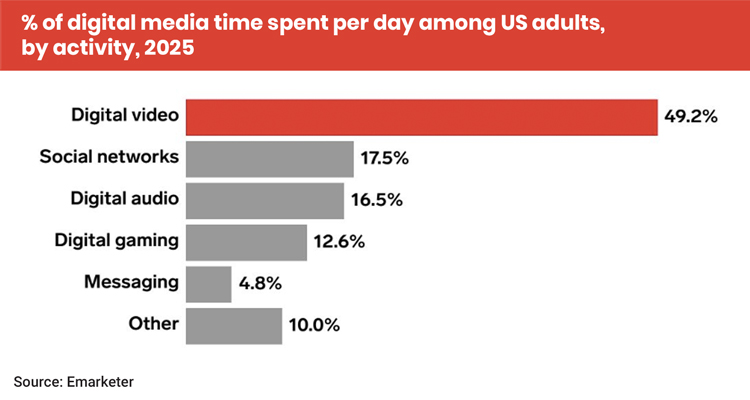
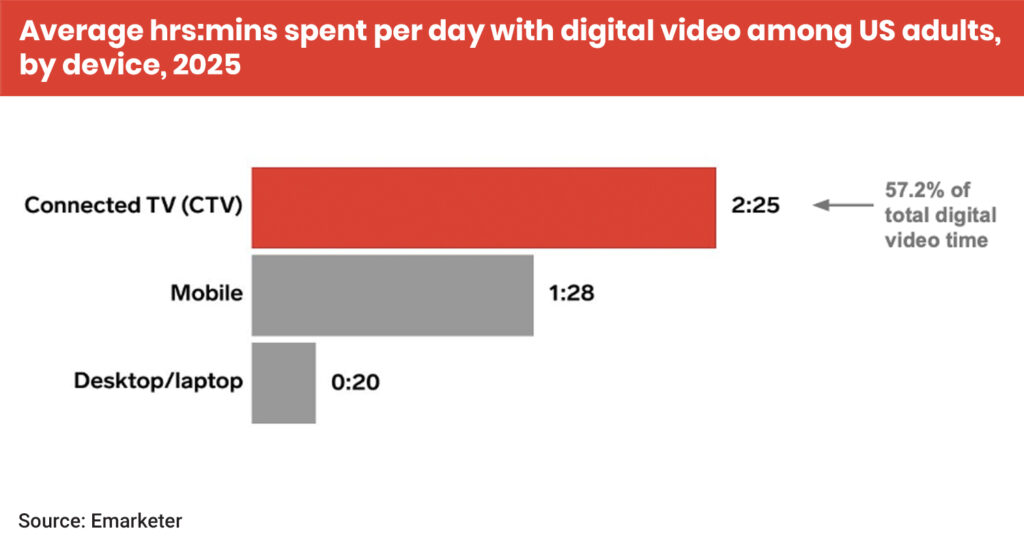
Digital video is consolidating its position as the dominant activity: it will grow by 5% in 2025 and by 2026 will account for half of total digital time, with more than half of adults’ online consumption devoted to videos by 2027. CTV leads with almost 2.5 hours of daily viewing, 57.2% of time spent on video, in parallel with the decline of traditional television. This trend shifts minutes of digital messaging usage toward more passive consumption, such as streaming and videos on social media.
Other activities that remain dynamic are online shopping, access to news, maps, and fitness services. Gaming remains relevant on various devices, and in audio, smart speakers already account for more than a quarter of listening time. In the mobile ecosystem, apps dominate: by 2027, they will account for 94% of usage time, compared to browsers, reflecting a preference for optimized experiences.
Adding to this dynamic is artificial intelligence in digital advertising: Netflix is projecting interactive ads powered by generative AI, while YouTube is experimenting with tools that automatically adjust the timing of ads, promising greater relevance and longer interaction times.
The report recommends that advertisers focus on creative video-based strategies tailored to CTV and mobile, invest in AI-driven personalization, and design differentiated content for each screen. It also suggests exploring emerging devices, such as connected cars, smart glasses, and virtual assistants, which currently represent a small portion of consumption but could be the next big areas of digital attention.