During a dedicated seminar at TIFFCOM 2025, leading members of the Broadcast Programming Association of Japan (BEAJ) offered insights into the challenges and rewards of international co-production, highlighting successful case studies and unveiling new strategies for global content distribution.
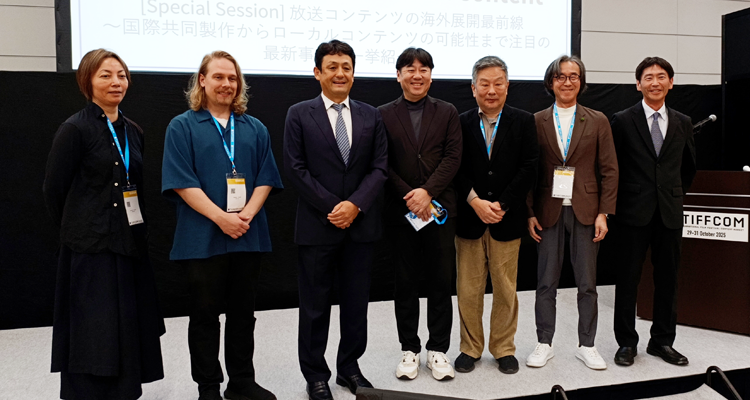
The session featured presentations from AXON, Asahi Broadcasting Corporation (ABC TV), NHK Enterprises, and the Local Content Bank (LCB) project, offering a comprehensive view of Japan’s evolving approach to international partnerships.
AXON: Lessons from a Finnish–Japanese Co-Production
Daniel Doyne of Nittere Vision and AXON presented a detailed case study on Barracuda Search, a Nordic mystery series co-produced by Japan’s WOWOW and Finland’s Nelonen. He described the demanding script development process as both a challenge and a valuable learning experience.
“The script was originally written in English and later translated into Japanese for the actors,” he explained. “We requested a literal translation first, and that revealed unnatural story flows and inconsistencies. We then had to revise the English version, secure approval from all partners, and repeat the process — including Finnish dialogue. It was time-consuming but essential.”
Doyne also noted key differences in production culture, particularly in Finland’s strict union system. “We could only shoot for 10 hours a day. If we extended to 12 hours, we could only film four days a week. It’s a sustainable system, but we had to adapt our schedule, holding script meetings on weekends to keep up.”
ABC TV: Co-Creation as a Global Strategy
Fumihiko Tsuji from Asahi Broadcasting Corporation (ABC TV) outlined the Osaka-based network’s strategy built around the concept of Co-Creation. He emphasized leveraging ABC’s unique DNA — blending comedy with heartfelt emotion — in collaborations with international partners who bring strong market insight, local marketing power, and global sales networks.
He presented successful examples such as The Secret Game Show, co-created with NBCUniversal Formats, where unsuspecting office workers are thrust into a hidden game show, and Miracle 100, produced with South Korea’s D.I.T. and Singapore’s E/O Media, a music program where performing groups must have a combined age of exactly 100 years.
“Our next step is to expand co-creation into drama,” Tsuji revealed, announcing a new partnership with South Korea’s premium studio Imaginus. “We are developing a drama together that we hope will resonate with audiences worldwide.”
NHK Enterprises: Leveraging Partner Strengths
Ryota Kotani from NHK Enterprises (NEP) shared insights from years of co-production experience with China, emphasizing that success depends on understanding each partner’s unique strengths.
Using the example of the beloved panda Xiang Xiang, Kotani explained: “For Japan, the panda itself is compelling content. For our Chinese partners, their strength lies in negotiation — pandas are a national treasure, and filming them requires government permits, which our partners obtain efficiently.”
He also highlighted NEP’s Half & Half production model. “There was no exchange of money. Instead, the Chinese side provided an excellent camera crew, and the Japanese side contributed the director to structure the story. We built one production together, sharing our strengths equally.”
Local Content Bank (LCB): Unlocking Japan’s Regional Treasures
Yutaka Oyamatsu from Television Miyako introduced the Local Content Bank (LCB), an ambitious initiative involving 63 local broadcasters across Japan. The LCB is a centralized database that aggregates and systematically tags short-form content from local TV stations, primarily focusing on regional cuisine, tourism, and lifestyle.
“The key function of the LCB is to create long-form playlists from short clips produced by local broadcasters,” Oyamatsu explained. “For instance, a search for ‘ramen’ can generate a 30-minute playlist featuring content from Hokkaido to Kyushu, all automatically compiled by our AI-based tagging system.”
Currently used as an internal tool, the project’s future vision is global. “We plan to create full transcripts and subtitles to streamline localization,” he added. “Our ultimate goal is to make this system available internationally — not only to distribute LCB-based programs, but also to offer the platform itself as a global solution.”
BEAJ: Connecting Japan with the World
The seminar concluded with a presentation by BEAJ itself, reaffirming its role as a central hub for promoting Japanese content worldwide. Shunsuke Ochiai highlighted its flagship online portal, the Japan Program Catalog (JPC), which aggregates content from over 50 Japanese rights holders and serves more than 1,000 registered international buyers.
BEAJ also actively promotes Japanese formats and dramas at key international markets such as MIPTV and the Asia TV Forum & Market (ATF), connecting its members with potential partners for co-production and distribution.
Japan’s Expanding Global Vision
Overall, the BEAJ seminar at TIFFCOM 2025 underscored Japan’s growing commitment to international collaboration — combining creativity, technological innovation, and strategic partnerships to strengthen the global presence of Japanese content.