What began as a digital curiosity in China and South Korea is now establishing itself as one of the biggest transformations in the global audiovisual industry. Micro-dramas (short stories, lasting one to three minutes per episode, designed for vertical viewing on mobile devices) are no longer an experiment: they are a multi-million-pound business that is redefining the language of streaming platforms and social media.
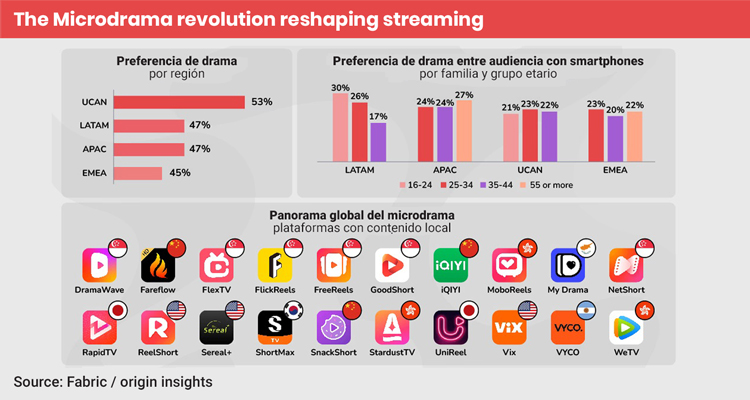
At MIPCOM 2024, the phenomenon took center stage. Asian producers, global distributors and new digital players agreed that the format is no longer a passing trend, but a sustainable model of production and monetization. Clare Thompson from K7 Media presented the report “Inside Microdrama: The Landscape in 2025 & Beyond”, in which she emphasized that microdrama ‘began as a niche experiment in Asia, but has rapidly grown into a global industry worth billions of dollars.’
The birth in Asia: innovation, speed and volume
China was the first major laboratory for the format. Platforms such as ReelShort, Douyin (TikTok China), Kuaishou and WeTV transformed audiovisual consumption habits by offering ultra-short series with cinematic aesthetics and addictive plots, many focused-on romance or youth drama.
According to data from K7 Media, the Chinese market alone currently employs more than 220.000 people, serves 662 million users and generates more than $5 billion annually. Growth was so rapid that the country became an exporter of know-how: engagement studies and algorithms, optimized narrative structures and distribution models based on artificial intelligence.
South Korea and Japan quickly followed suit. In Korea, micro-dramas were integrated into the K-content ecosystem, with productions designed for smartphones and platforms such as Naver TV and KakaoPage, which then scaled up to YouTube and Netflix. In Japan, “vertical dramas” also won over an audience that consumes entertainment on public transport, reinforcing the culture of “snack content”.
From Asia to the world:
Asian success sparked global competition. The United States experimented with Quibi in 2018 (an idea ahead of its time) but it was the Asian model that ultimately proved sustainable. With low production costs, rapid story turnover, and accurate engagement metrics, the format became irresistible to international platforms.
In Latin America, the phenomenon has already arrived with force: TelevisaUnivisión‘s ViX MicrO is committed to free distribution, while China’s ReelShort has formed strategic alliances with Caracol TV in Colombia and landed in Mexico, Brazil, and Argentina. In the latter country, VYCO is positioning itself as a new local player, combining original production and regional talent development.
A global language:
More than just a trend, microdramas represent a new audiovisual grammar. Compressed narrative, vertical format and emotional immediacy combine with algorithms that detect retention patterns and personalize the viewer’s experience.
As Thompson pointed out, ‘microdrama is closing the gap between traditional storytelling and the creator economy. It’s not just short: it’s immersive, serialized and designed to hook you in seconds’.
What’s next:
K7 Media projects that by 2026, microdrama will be a hybrid space where creativity and commerce converge: an incubator for ideas, genres, and emerging talent. Asia, its birthplace, will continue to lead innovation, exporting not only formats but also narrative strategies that are shaping the future of streaming.