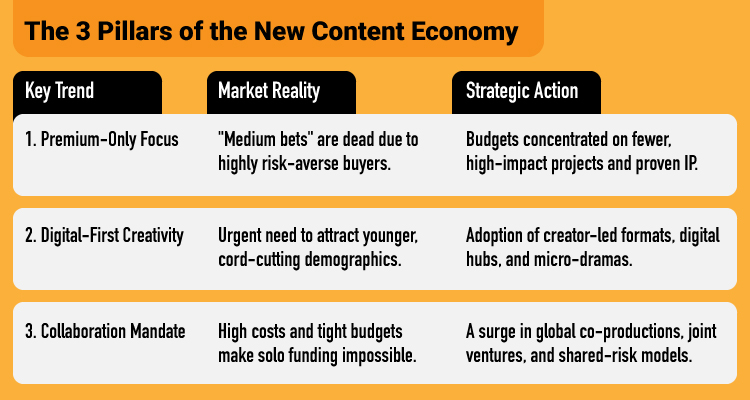
Due to the London TV Screenings presentations, three big concepts have been remarked: to provide just premium content, to have real success chances in the market; fresh creativity, based on the Digital First people and contents, plus new origins (more exotic, better) to change the current perspectives; and collaborations, with co-productions, co-developments, co-marketing, as a main key factor to move forward globally in contents. Nobody, from Hollywood Studios to Google, can alone at these times.
The end of the «medium bet»
The financial realities of the current media landscape have effectively eliminated the middle ground. The overriding consensus from presentations by major players like ITV, Banijay, Warner Bros. Discovery, and Sony is that the market no longer has an appetite for ‘medium bets’.
Buyers remain risk-averse, yet the demand for high-end, premium scripted programming remains strong. This dynamic is forcing studios to concentrate their budgets on fewer, but larger, impact-driven projects. Mike Beale, head of formats at ITV Studios, summarized this shift by noting that producers must launch ‘very strong contents to make a difference’, across both scripted and unscripted genres. This trend toward premium-only slates is visible in big-budget historical dramas, as well as the reliance on spin-offs, sequels, and prequels to mitigate financial risk.
Fresh creativity: the digital-first infiltration
To refresh linear screens and attract younger demographics, traditional television is turning directly to the creator economy. The industry acknowledges that to evolve, it must integrate Digital First experiences, YouTube creators, and diverse new origins into its core programming.
This is no longer a theoretical strategy; it is actively shaping acquisitions and corporate structures:
- Creator-Led Formats: Banijay Entertainment recently acquired the international rights to Stop The Train, a digital-first format originally created by French YouTuber Squeezie, which proved its viability online before transitioning to the traditional distribution market.
- Dedicated Digital Hubs: During the London TV Screenings, ITV Studios announced the launch of Studio 55, a new division specifically designed to co-create digital-first formats and integrate brands with its global intellectual property portfolio.
- The Micro-Drama Boom: Reflecting the influence of Asian digital markets, micro-dramas and the adaptation of traditional programming into vertical formats were among the most discussed topics during the screening week.
The collaboration imperative
With budgets tightening and the cost of premium production rising, isolated operational models are becoming obsolete. As Beale stated during the screenings, ‘the partners are as important as customers for the success of a content’.
This collaborative mandate is driving a wave of co-productions, joint ventures, and shared-risk models across the industry:
- Strategic Alliances: Sony Pictures executives emphasized that their strategy relies heavily on exploring co-productions, pre-buys, and strategic partnerships across the EMEA region to accelerate their premium scripted output.
- Consolidated Distribution: Companies are merging their strengths to navigate the fragmented landscape. Insight TV and Off the Fence utilized the London Screenings to spotlight their joint venture, the World Storytelling Media Group, combining Off the Fence’s unscripted sourcing capabilities with Insight TV’s global channel network.
- Hyper-Distribution: The market is adopting «Hyper distribution» models, where public broadcasters, mid-sized producers, and online communities pool resources to bypass traditional distribution limitations and achieve global reach.