
A rapid acceleration in global internet regulations aimed at protecting children is threatening to trigger a market failure in the kids content industry. With governments implementing strict access laws and major digital platforms deploying opaque algorithmic moderation, producers and independent creators are facing an environment where producing children’s media is quickly becoming economically unviable.
The regulatory framework is tightening across multiple major territories. Australia has enacted a social media ban for users under 16, while France is targeting September 2026 for similar enforcement. Denmark is actively evaluating comparable measures, and the U.S. state of Virginia has proposed a one-hour daily limit on social media for minors. Compounding these governmental actions are stringent privacy enforcements, highlighted by recent fines levied against Disney for violating children’s privacy laws on YouTube in the U.S. While the necessity of child safety online is undisputed across the industry, the current trajectory of these broad regulatory strokes risks driving creators, production companies, and investors out of the market entirely.
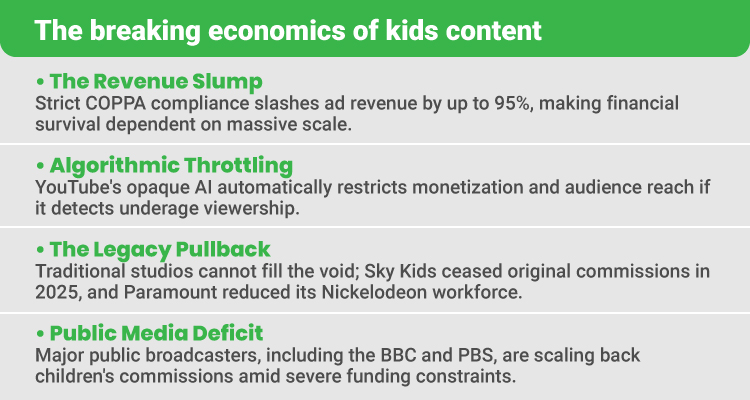
Platform-level policy shifts are severely exacerbating this industry squeeze. YouTube recently rolled out AI moderation software designed to identify whether an audience skews young based on user activity, regardless of whether the creator explicitly tagged the video as ‘Made for Kids’. If the AI categorizes the viewership as underage, the platform automatically throttles revenue by restricting algorithmic reach and disabling personalized ads.
For independent creators, this creates an unpredictable ecosystem where they cannot strategize against criteria they cannot see. The economics of children’s digital content were already highly fragile; operating under strict COPPA restrictions typically slashes ad revenue by up to 95%, making financial survival dependent on massive scale, such as the volumes achieved by operations like Moonbug. As automated systems actively recategorize content without user opt-in, the financial risk for independent producers heavily outweighs the potential reward, forcing many to abandon the demographic.
As independent creators exit this high-risk sector, legacy media and public broadcasters are not positioned to fill the resulting void. Traditional powerhouses are navigating their own structural challenges, evidenced by Paramount‘s recent layoffs at Nickelodeon and Sky Kids ceasing original commissions in 2025. Similarly, public broadcasters like the BBC, ABC, and PBS are commissioning less children’s content as they grapple with internal funding constraints and negotiate their value propositions with governments. The assumption that regulatory tightening will naturally shift production opportunities back to legacy or public media ignores the reality of their currently depleted resources and mandates.
The industry is now facing a realistic market failure scenario. The unintended consequence of aggressive regulation and platform de-risking is a highly fragmented landscape where children might be driven toward VPN workarounds, age-verification bypasses, and closed social platforms to find entertainment. Alternatively, the market may simply be left with a handful of well-funded producers creating sterile content that satisfies regulatory checkboxes but fails to engage its target audience.
The core distinction lies between smart regulation that creates industry guardrails and blunt regulation that inadvertently burns down the ecosystem. Currently, the safest business decision for many media companies is to avoid making kids content altogether. As the sector navigates 2026, the primary challenge is no longer just creating high-quality children’s media, but rather ensuring the landscape remains financially viable enough for anyone to justify creating it at all.