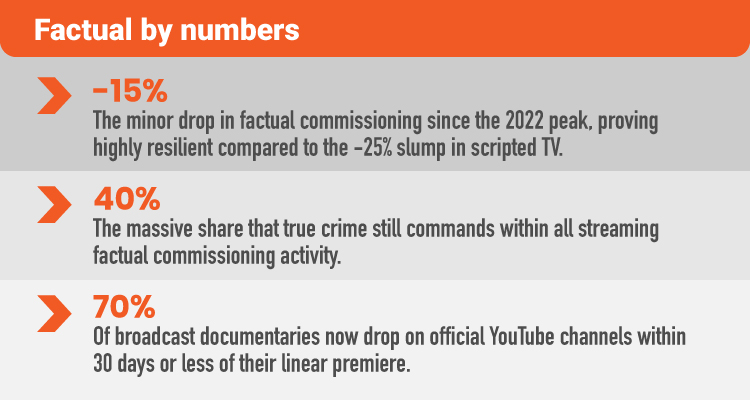
The factual television sector is exhibiting notable resilience compared to the broader scripted landscape, acting as a key area of opportunity for the global entertainment industry. According to data compiled by Ampere Analysis and presented at last edition of Mip London, past February, the volume of unscripted and documentary commissions has contracted by only 15% from its historical peak, contrasting with the 25% decline observed in scripted programming since the industry’s «Peak TV» high point in 2022.
The analysis, titled “10 Factual Facts to Flourish in the Future” and presented by Executive Director Guy Bisson, highlights Western Europe as a primary hub for documentary activity. While other global territories have registered slight drops, commission volumes in the region have stabilized, specifically across cultural, crime, biographical, and historical subgenres. Following a minor dip in early 2025, commissioning volumes in both North America and Western Europe are currently returning to steady 2024 baselines.
A significant factor stabilizing unscripted television metrics is the steady rise in sports-related content. As global streaming platforms increasingly acquire live sports rights, they are concurrently greenlighting adjacent documentary formats—such as behind-the-scenes profiles and serial narratives—to maximize their sports portfolios. This demand is further accelerated by major international events, including the upcoming Winter Olympics and the FIFA World Cup. While original sports docuseries orders by the top six global streaming services saw a slight correction in 2025, volumes are projected to peak in alignment with these tournament cycles.
Concurrently, traditional subscription-based and commercially-driven players are pulling back from unscripted commissions across most genres, a structural shift that may be linked to consumer behavior on digital platforms. Bisson noted a potential parallel to children’s media programming, suggesting that adult audiences are increasingly migrating to YouTube for unscripted and documentary content. In response to this audience shift, traditional broadcasters are re-evaluating distribution windows; approximately 70% of broadcast documentary titles are now being published to networks’ official YouTube channels within 30 days or less of their linear television premieres.
As commercial networks, legacy pay-TV operators, and SVOD services scale down unscripted investments, public service broadcasters are solidifying their roles as the primary commissioners of documentary programming. Public broadcasters have demonstrated an ability to move quickly on topical issues, increasing their output in news-adjacent subgenres such as military/war, culture, and social health—including investigative pieces on children’s mental health and social media. These networks are leveraging their structural advantage to adapt and repurpose existing catalog materials rapidly to address current events, a flexibility that global streamers are generally less equipped to replicate.
The data reveals a clear divergence in what commissioners are seeking, despite certain areas of overlap. True crime remains highly stable, representing 40% of all streaming unscripted commissioning activity. However, streamers are specifically prioritizing projects that offer a completely fresh or untold perspective, expose institutional secrets, or highlight the personal cost and sacrifice within sports or music landscapes. Conversely, when traditional broadcasters approach true crime or historical topics, they are actively looking for concepts framed around a distinct social angle, collective trauma, or stories that explicitly connect historical legacies to modern societal challenges.