The latest iteration of the Nostradamus Report shifted away from predictive warnings to focus heavily on systemic recalibration during its unveiling at the recent Cannes Next program, past month. Authored by media analyst Johanna Koljonen, the document, titled “Challenging Projections,” presented a major overhaul of the frameworks used to evaluate, quantify, and navigate the modern audiovisual landscape. Sponsored annually by the Göteborg Film Festival for over a decade, the study compiles insights from cross-sector interviews to correct what it identifies as a widespread bias toward interpreting market evolution through anxiety or nostalgia rather than empirical data.
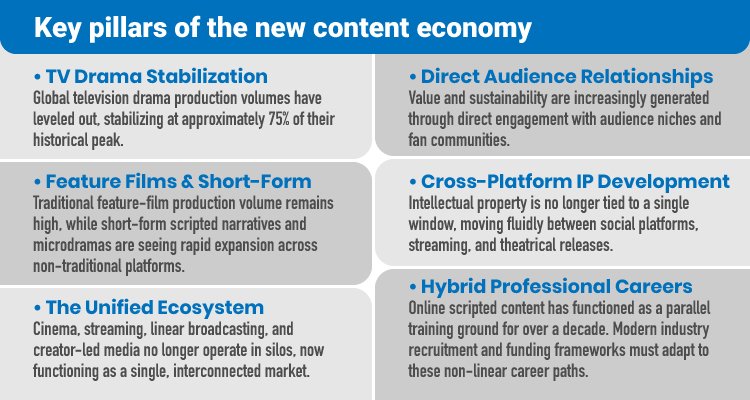
At the core of the findings is the reality that cinema, traditional broadcasting, streaming services, and online creator media have merged into a singular, highly fluid environment. Within this integrated structure, television drama volumes are flattening out at approximately three-quarters of their historical peak, while independent feature film output remains robust. Simultaneously, microdramas and short-form scripted narratives are proliferating on alternative platforms. Koljonen noted that the traditional screen industries previously viewed the creator ecosystem and non-traditional video formats as abstract concepts, but recent theatrical features led by online creators and the massive surge in micro-content have forced a realization that the map of the media ecosystem has fundamentally changed.
The research highlights the consolidation of a decentralized economy driven by direct consumer engagement, multi-channel monetization, and cross-platform intellectual property expansion. The document directly challenges institutional biases regarding online creators, noting that internet-native scripted content has served as a parallel training arena for industry professionals for more than ten years. The study argues that failing to integrate these non-linear career trajectories into traditional funding, recruitment, and organizational frameworks is increasingly unsustainable. Furthermore, it suggests that regional film sectors, particularly in Europe, have historically misjudged audience demands by falsely equating broad commercial popularity with a lack of artistic merit, whereas accessible storytelling is actually vital for maintaining cultural presence and fiscal health.
Consequently, the study advocates for a complete redefinition of market success. Instead of evaluating performance solely through traditional box office results or isolated broadcast windows, it suggests measuring the aggregate vitality of creators, production firms, and audience communities. This change in perspective requires recognizing that significant economic and cultural value now accumulates in digital spaces where current measurement tools remain inadequate. Industry professionals contributing to the research—including executives from Warp Films, WEBTOON Productions, and European Film Promotion—pointed out that professional entry points are no longer linear, and that highly active fan communities are now structural components of intellectual property development rather than mere marketing tools.
The analysis concludes that the primary obstacle facing the global entertainment sector is not rapid technological change, but an inability to interpret the current landscape objectively. The overarching priority for media firms is to understand the system as it operates today rather than attempting to resurrect past structures. To support this ongoing analysis, the initiative is expanding its reach beyond its annual festival presentation through the launch of a dedicated newsletter and an upcoming podcast series.