The long-standing walls of streaming exclusivity are steadily coming down across the APAC region. Driven by rising customer acquisition costs and the pressure to maximize returns on local intellectual property, major OTT platforms are increasingly licensing, co-streaming, and bundling content with direct competitors.
Nowhere is this pragmatic shift more visible than in India, where popular non-fiction and creator-led formats are crossing platform boundaries at an accelerated pace. Iconic MTV franchises such as Roadies and Hustle—whose digital rights are held by JioStar—are now streaming on Netflix, alongside breakout YouTube properties like Samay Raina’s India’s Got Latent and Kamiya Jani’s Sunday Brunch.
At the core of this strategy is a desire to mitigate risk and reduce marketing spend. Launching original IP from the ground up requires heavy promotional investment, whereas licensing established formats delivers built-in viewership. ‘For any network to acquire them or stream these shows on its platform makes sense because establishing a new format requires a lot of marketing effort. If something is already established and people know what it is, your marketing effort goes down substantially’, explained media and content strategy consultant Ashish Golwalkar.
Industry analysts note that global streamers have been particularly active in tapping into this model to capture multi-screen engagement across mobile, television, and connected TV. ‘Over the past 12 months, non-fiction has assumed greater importance in this strategy. Netflix is increasingly buying proven audiences rather than building new IP from scratch’, said Mihir Shah, VP at Media Partners Asia, pointing to titles such as The Great Indian Kapil Show, Lock Upp, and Desi Bling, as well as simultaneous streaming runs like India’s Got Latent across YouTube and Netflix.
When structured effectively, this modern iteration of classic syndication generates value across the entire ecosystem. ‘The original rights holder earns incremental licensing revenue, the acquiring platform gains established content to strengthen its catalogue and creators and publishers can monetise their work through additional distribution channels’, noted Anup Chandrasekharan, COO–regional at The EPIC Company. Commercial terms remain flexible; according to a JioStar spokesperson, ‘Each arrangement has its own nuances, structured depending on the outcomes both parties seek’.
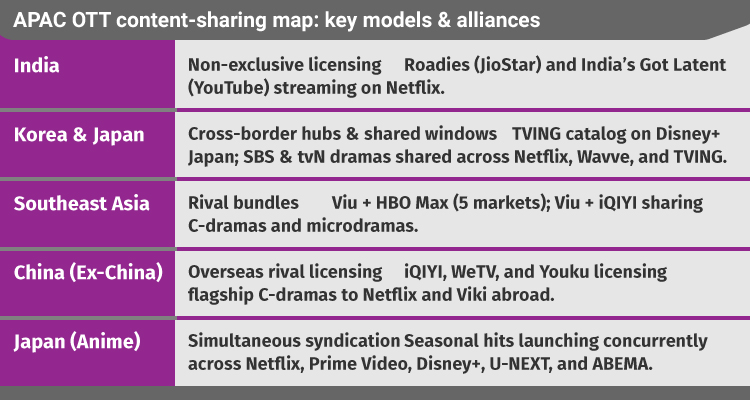
India’s content-sharing wave mirrors a broader structural realignment unfolding across Asia-Pacific, where rival platforms are trading strict exclusivity for scale and international reach:
In Japan and South Korea, Disney+ struck a landmark deal with CJ ENM in late 2025 to integrate originals and catalog titles from South Korea’s leading local streamer, TVING, directly into Disney+ Japan. The move provides TVING with international expansion without the overhead of launching a standalone Japanese app, while bolstering Disney+’s K-content slate against Netflix. Similarly, the big N has leaned heavily into shared windowing in South Korea—signing a multi-year deal with broadcaster SBS for dramas and variety shows that simultaneously feed local OTT Wavve, while continuing to share day-and-date releases from CJ ENM (tvN) and JTBC alongside TVING.
In Southeast Asia, PCCW-owned pan-regional streamer Viu has made rival collaboration a pillar of its growth strategy. Viu launched a joint bundle with HBO Max across Indonesia, Malaysia, the Philippines, Singapore, and Thailand—pairing Hollywood tentpoles with Asian dramas to rival Netflix’s scale—and forged a parallel alliance with iQIYI International to cross-pollinate audiences across Chinese dramas, Southeast Asian originals, and microdramas.
Meanwhile, China’s streaming giants—iQIYI, Tencent’s WeTV, and Youku—fiercely guard exclusivity domestically, yet operate with far greater openness abroad, regularly licensing their flagship C-dramas to direct competitors like Netflix and Rakuten Viki to maximize global monetization. Japan, the region’s longtime pioneer of content-sharing, continues to set the pace through its anime production committee model, where non-exclusive licensing routinely places major seasonal anime releases simultaneously across Netflix, Prime Video, Disney+, U-NEXT, and ABEMA to prioritize mass reach and merchandising over platform lock-in.
Still, broader availability carries commercial trade-offs, particularly regarding subscriber cannibalization and brand differentiation. Divya Dixit, CEO of Recz and former SVP of marketing at ALTBalaji, warned that visibility does not automatically translate into profitability. ‘Everyone can benefit, but announcing a partnership and making money from it are two different things’, she cautioned. ‘Putting content everywhere doesn’t automatically grow the business. Someone discovering a show on YouTube may be a new viewer, while an existing subscriber could simply switch to the free option’.
Pricing tiers and user experience also dictate where overlapping audiences choose to watch. In India, JioStar’s affordable, ad-supported tiers cater to price-sensitive consumers, while Netflix’s premium, largely ad-free environment appeals to viewers seeking uninterrupted playback—though JioStar’s own premium tier complicates a simple price-versus-ads comparison. Ultimately, while a marquee show can attract a viewer, long-term retention still hinges on the broader library.
For that reason, many executives insist that exclusivity remains vital. Alisha Coelho, senior VP – platform management and business head – AVOD at ZEE5, pointed out that while selective partnerships—such as ZEE5’s past collaborations with TVF on Aam Aadmi Family—can combine creative strength with distribution scale, total openness would erode brand value. “If all our content were available everywhere, viewers would have little reason to choose ZEE5. The platform with the widest distribution could become the default destination, diluting the value of the IP for the rights holder,” she said. JioStar’s spokesperson offered a slightly different perspective, arguing that wider reach can elevate a franchise as long as ownership stays intact: “Licensing a show out doesn’t mean giving up ownership, but it does alter the show’s exclusivity to the original platform.”
The rise of shared content also presents a complex equation for advertisers. Platforms frame multi-platform distribution as an expansion of brand touchpoints. A YouTube spokesperson emphasized that its ad-supported and subscription models ‘work to optimise viewer engagement, expand advertiser reach, and ensure creators can effectively monetise their content across various formats and audiences’, while JioStar noted that ‘every new touchpoint opens up opportunities for brands to reach consumers wherever they are’.
Media buyers and analysts, however, stress the need for clearer measurement to separate genuine incremental reach from duplicated impressions. ‘Ultimately, the objective is not simply to maximise views but to improve incremental reach and the effectiveness of media investment’, Chandrasekharan stated. Dixit echoed the concern over audience overlap: ‘The same person watching across three platforms is still only one potential customer. Without understanding that overlap, brands can end up paying repeatedly to reach viewers who’ve already seen the campaign enough times’.
Alberto Buitron