
AI is no longer just a hypothetical talking point in studio boardrooms; it is quietly finding its way onto call sheets and edit suites. Yet beneath the creative anxiety surrounding automated scripts and synthetic actors lies a much harder commercial calculation. Studio heads and financiers are no longer debating whether software will alter how movies and series get made, but rather how fundamentally it will dismantle and reassemble where the industry’s money actually flows.
According to a comprehensive industry analysis tracking the historical impact of technological shifts, the mass adoption of generative AI could trigger a massive financial realignment. If the deployment of artificial intelligence mirrors past disruptions—such as the transition to digital cinematography or the rise of home video—market researchers estimate that up to $60 billion in annual industry revenue could be redistributed across the sector within five years of the technology achieving mainstream scale.
A squeeze on legacy economics
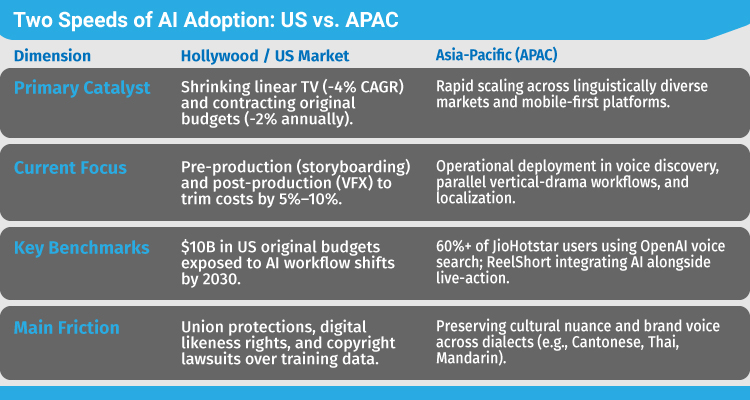
This technological wave is crashing into an industry that is already hemorrhaging traditional viewership and facing severe financial headwinds. Data analyzing media consumption trends from 2022 to 2024 reveals a stark migration in audience behavior. According to recent market reports, daily viewing hours for linear television in the United States plummeted by a compound annual growth rate (CAGR) of 4 percent during that period. Conversely, digital alternatives surged, with streaming viewership climbing by 13% and social video platforms jumping by 14%.
Compounding this fragmentation of attention is a tightening of Hollywood’s purse strings. Analysts project that spending on original content in the United States—which accounts for more than half of all global production expenditures—will contract by 2 percent annually as networks pivot toward live sports and cheaper licensing deals. Crucially, this forecasted decline does not even account for the looming financial shockwaves that AI automation might introduce.
While long-term scenarios remain highly speculative, the immediate effects of AI are already visible in specific operational trenches. Production companies experimenting with generative algorithms are reporting productivity boosts ranging from 5 to 10 percent in select workflows this year, according to industry surveys.
Currently, the most aggressive implementation is happening at the bookends of the manufacturing process: pre-production and post-production. Visualizing scripts, storyboarding, and A/B testing narrative beats are highly compatible with today’s AI capabilities. By streamlining these early phases, producers are attempting to shift the old industry adage of «fixing it in post» to «fixing it in pre.» Meanwhile, post-production tasks like localization, digital dubbing, and visual effects rendering are being rapidly automated.
However, physical production—the actual on-set shooting and set construction—remains largely insulated for now. Industry leaders point to a mix of inadequate tool quality, fierce union protections, and a fundamental desire to maintain creative integrity as barriers keeping AI off physical sets. Nevertheless, the financial incentive to digitize these stages is immense. Analysts forecast that by the year 2030, roughly $10 billion of American original content budgets will be directly exposed to AI-driven workflow modifications.
APAC’s operational leap: Discovery, pipelines, and localization
While Hollywood navigates legacy budget contractions and union guardrails, the Asia-Pacific region is aggressively moving AI from theoretical panels to everyday operational reality. Speaking at APOS 2026, Media Partners Asia (MPA) CEO Vivek Couto underscored this shift, noting that the technology is now deeply embedded across the region’s media stack. The conference agenda itself reflected this acceleration, featuring dedicated deep dives into GenAI across the content pipeline—with executives such as JioStar’s Stephan Bugaj and FBRC.ai’s Todd Terrazas—alongside sessions on AI-native filmmaking and video generation.
Concrete deployments are already reshaping consumer behavior and production workflows in APAC. At JioHotstar, chief architect Vijay Seshadri revealed that the platform’s conversational voice discovery tool, built in collaboration with OpenAI, has fundamentally altered how audiences navigate its catalog, with over 60% of users now opting for voice over text to find content. On the production side, major vertical-drama operators like ReelShort are actively structuring AI as a parallel workflow designed to operate alongside traditional live-action shoots.
Nowhere is AI’s immediate return on investment more tangible in Asia than in post-production and localization. Historically, the region’s vast linguistic diversity forced studios and brands across Hong Kong and APAC to treat every language cut—spanning English, Cantonese, Mandarin, Japanese, Korean, and Southeast Asian languages—as a separate, costly production requiring recasting, reshoots, or lengthy delays until the next budget cycle.
Today, AI-driven localization allows companies to transform a single approved «hero» asset into a multi-market language pack without booking a second shoot. Advanced platforms like Kling 4.0 have even begun supporting hyper-specific regional nuances, including Cantonese dialects and accents. As adoption matures, APAC buyers are also becoming more technically precise, moving away from treating «AI video translation» as a catch-all term. Instead, post-production briefs now draw sharp distinctions between translation (adapting scripts and subtitles), dubbing (replacing the dialogue audio track), and lip-sync (aligning mouth movements to the new audio)—all of which must be paired with cultural transcreation to ensure the final cut preserves authentic brand voice and narrative resonance rather than sounding like a literal transplant.
The democratization threat and financial cannibalization
Historically, breakthroughs in production technology—from CGI to advanced cameras—have concentrated wealth at the top, benefiting large tech vendors and major distributors. Currently, just seven corporate buyers control 84 percent of all US content spending. If AI simply makes the existing studio system faster and cheaper, these mega-distributors are positioned to absorb the lion’s share of the profit margins.
However, artificial intelligence represents a unique historical anomaly: it possesses the capacity to democratize professional-grade cinematic creation. If independent creators and smaller studios can suddenly generate blockbuster-quality visuals from their laptops, the resulting tsunami of content could fundamentally dilute the market share of legacy IP owners.
The financial threat of this democratization is severe. Industry modeling suggests that if user-generated, AI-empowered open platforms capture just a 5% incremental share of current TV and film viewership, legacy distributors would suffer a devastating $13.2 billion revenue wipeout. Because open-web platforms monetize audiences at significantly lower rates than premium subscriptions or theatrical releases, those platforms would only generate $7.5 billion from that captured attention. The result would be a net destruction of $5.7 billion from the global media economy, vaporized simply by a shift in where audiences choose to spend their time.
Ethical minefields and labor pushback
Despite the economic allure, the road to algorithmic production is littered with legal and ethical landmines. The recent strikes by Hollywood’s writers and actors underscored a deep-seated labor panic regarding job displacement and the unauthorized replication of digital likenesses. Talent agencies are actively scrambling to establish new legal perimeters to protect their clients from unauthorized deepfakes and algorithmic cloning.
Furthermore, major studios are locked in fierce legal battles with tech companies, alleging that foundational AI models were illegally trained on copyrighted cinematic libraries. Executives warn that any commercial content utilizing AI must navigate strict «nutrition labels» regarding its training data to avoid catastrophic copyright infringement liabilities. Beyond legalities, the technology still wrestles with algorithmic bias—such as generating stereotyped casting suggestions or homogenous marketing imagery—which requires intense human oversight to correct.