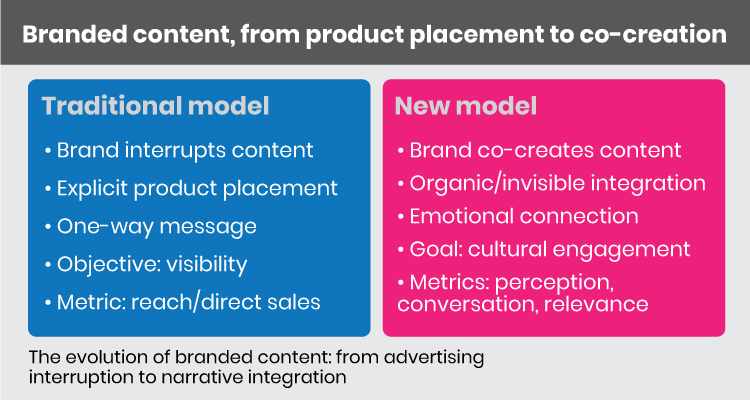
For years, branded content was synonymous with forced insertions, obvious placements, and products pushed into stories that didn’t need them. Today, that model seems definitively exhausted. Instead, the global audiovisual industry (from Hollywood to Europe, from Asia to Africa) is undergoing a phase marked by co-creation, where brands no longer seek to interrupt entertainment, but rather to finance it, enhance it, and become part of its narrative DNA.
This transformation was evident during Natpe Global, at the Co-Lab conference, with a panel that brought together leaders from Sugar 23, Hartbeat, and Publicis. Moderated by Roko Izarra, the executives agreed on a compelling diagnosis: branded entertainment works when the story comes first and the brand accepts moving away from center stage.
One of the most cited examples was Group Therapy, the documentary series produced by Hartbeat and financed by AXA. The insurance company does not appear on screen or is mentioned at any time. Its role was different: to support a project that sought to destigmatize mental health through real conversations between comedians, led by Neil Patrick Harris. Comedy served as a vehicle for addressing complex issues, and the content found its audience on YouTube, with a second life at international festivals and awards.
Women’s Sports Now, promoted by Publicis alongside Roku and Hello Sunshine, took a similar approach. The project was based on a clear fact—the audience for women’s sports doubled between 2022 and 2024—and an obvious gap: there was no weekly space dedicated exclusively to that universe. Here, the brand did not “sponsor” existing content, but helped to create it, positioning itself as an ally of an expanding cultural conversation.
This change is neither isolated nor exclusive to the United States. In Europe, branded content is increasingly integrated into co-production schemes and transnational funds, with a focus on cultural and social values. In Asia, where mobile consumption dominates, brands develop local narratives designed for specific platforms and audiences. In Africa, growth is driven by stories rooted in local identities and languages. In all cases, the logic is the same: authenticity over visibility.
The measurement of success has also been redefined. “It’s very difficult to attribute direct sales to a film or series,” said Matt Rotondo from Sugar 23. The focus has shifted to metrics of cultural engagement, brand perception, and social relevance. Global reach, conversation, awards, and creative legitimacy now carry more weight than traditional exposure.
Cases such as The LEGO Movie, Barbie, BMW Films‘ The Hire, and Red Bull‘s content ecosystem confirm this evolution: when a brand respects the logic of entertainment and is committed to creative quality, it can transform itself into a true content studio.
The panel’s final message was clear and resonates throughout the industry: brands are willing to relinquish creative control if the content is good. They no longer seek to “occupy spaces,” but rather to integrate themselves meaningfully. In contemporary branded content, it is not the loudest voice that wins, but the one that tells the best story.