The bundling model, which groups multiple streaming services under a single subscription or interface, has become one of the pillars of the digital transformation of entertainment in Asia, a region where technology adoption and competition between platforms are reaching unprecedented levels.
While in the West, bundling is emerging as a response to market saturation, in Asia it is already consolidating as a mature ecosystem, driven by telcos, superapps and local aggregators that integrate video, music, gaming and e-commerce into a single experience.
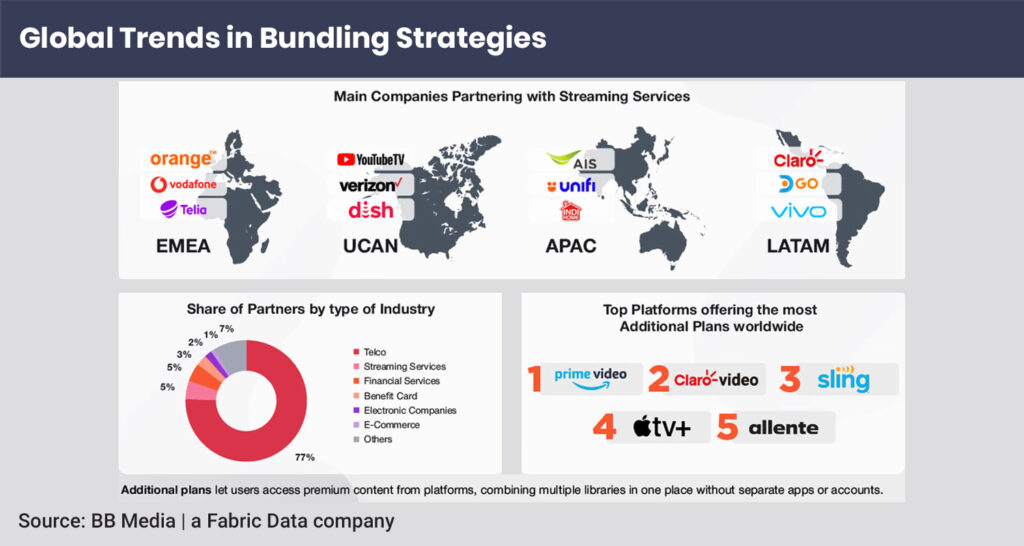
According to data from Media Partners Asia (MPA), 70% of video-on-demand users in the region access content through bundles or aggregators. In markets such as India, Indonesia, South Korea and Japan, the growth of SVOD subscriptions is directly linked to integration with telecommunications operators and multipurpose platforms.
Companies such as Jio Platforms (India) and Telkomsel (Indonesia) are leading the way with models that combine services such as Netflix, Disney+ Hotstar, SonyLIV and Amazon Prime Video within their mobile or fiber plans. In South Korea, SK Telecom is positioning itself as an entertainment hub with its Wavve platform, the result of a partnership between the telco and the main national channels (KBS, MBC and SBS).
Meanwhile, Rakuten TV in Japan and HBO Go Asia have opted for integrations through Rakuten Mobile and Singtel (Singapore), showing how regional bundles adapt to local consumption habits and the linguistic diversity of each market.
Southeast Asia represents the most advanced laboratory for digital bundling. Superapps such as WeTV (Tencent), Viu (PCCW Media) and iQIYI offer not only streaming within their ecosystem, but also microtransactions, e-commerce and gaming, under hybrid SVOD + AVOD + live TV schemes.
In addition, aggregators such as Astro (Malaysia) and TrueID (Thailand) integrate international content with local productions, allowing users to manage access to multiple services from a single interface. This has boosted subscriber retention and reduced cancellation rates, a recurring challenge in mature markets.
Unlike Latin America or Europe, where bundling still depends on bilateral agreements, in Asia the phenomenon is already part of the market’s DNA. Bundling is not just a commercial solution: it is a technological convergence strategy, supported by mobile penetration and a preference for ‘all-in-one’ models.
Consulting firm Omdia estimates that 45% of SVOD revenue in Asia will come from integrated bundles by 2027, while the growth of local aggregators will double the number of active subscribers over the next five years.
In an environment where competition for user time and spending is intensifying, Asia is leading the evolution of bundling as a sustainable model for streaming. Partnerships between telcos, OTT platforms and superapps are redefining not only content distribution, but also the way we understand the digital economy.
The future of global entertainment could have its roadmap written in Asia: integration, convenience and multi-platform access as drivers of the new audiovisual ecosystem.