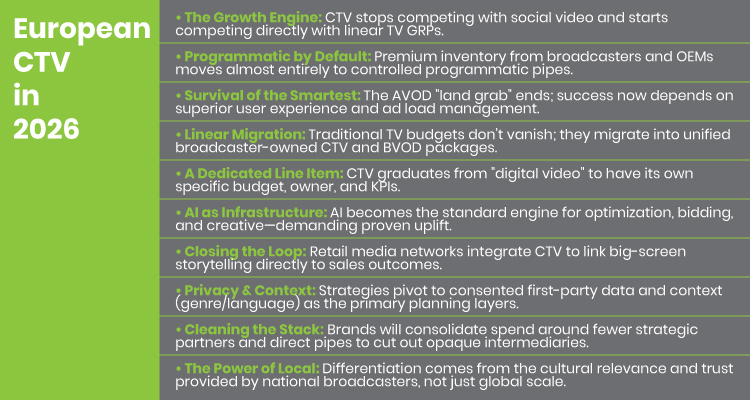
CTV in Europe has long occupied a liminal space in media planning, viewed as too significant to ignore yet often treated as a secondary, experimental channel sitting somewhere between traditional television and digital video. In 2026, this transitional phase is effectively concluding, with the medium establishing itself as a primary building block of the European advertising ecosystem.
With global CTV ad spend forecast to reach approximately 46 billion dollars—accounting for nearly 24% of all video ad spend—the region is set to be a primary driver of this acceleration, according experts.
The fundamental question for marketers has shifted from the feasibility of testing the platform to maximizing its full strategic potential beyond simply adding incremental impressions on a different screen. This maturation is reshaping budget allocations, operational infrastructure, and content strategies across the continent.
The migration of linear budgets
While traditional linear TV budgets in Europe remain flat or face decline, the erosion is flowing directly into broadcaster-owned CTV and BVOD ecosystems rather than vanishing entirely. Broadcasters are increasingly pushing unified packages that price linear and streaming reach together to retain investment within their environments. This migration is supporting a broader European ad market forecast to grow by roughly 5% to 165 billion dollars, while OTT and AVOD sectors have recorded CAGR of between 55% and 57% in recent years.
Consequently, CTV is moving from a general digital video line item to a dedicated place in media plans with specific ownership. KPIs are evolving from simple completion rates to sophisticated metrics regarding incremental reach against linear TV and cross-screen frequency.
This significant structural change that has accompanying this financial shift is the adoption of programmatic buying as the default mechanism rather than an exception. Data indicates that more than 40% of advertisers now allocate at least 11% of their total budgets to CTV, a figure that rises to 51% among respondents in Southern and Western Europe. As a result, the majority of premium inventory from broadcasters and OEMs is moving behind controlled programmatic pipes, prioritizing efficiency and waste reduction.
The sector’s maturation is further evidenced by its burgeoning integration with retail media networks, which helps close the loop between big-screen storytelling and sales outcomes. Although only roughly 19% of retailers currently offer CTV placements, the format already captures around 31% of offsite retail media budgets within a European retail media sector that has grown 21.1% year-on-year to reach 13.7 billion euros.
The battle for content and viewer attention
The surge in investment tracks with an explosion in consumption across free, ad-supported platforms. In 2025, six of the ten fastest-growing VOD catalogues globally were free services, with Tubi UK jumping 99%, France’s TF1+ rising 77%, and Spain’s RTVE Play growing 37%. Globally, AVOD has become a 40-billion-dollar market growing at over 8% annually. However, the initial phase of launching countless channels is giving way to a «survival of the smartest» environment, where success depends on user experience and ad load management rather than volume.
Local players are proving particularly resilient against global giants in this arena. TF1+, for instance, now holds an estimated 7% share of France’s roughly 2-billion-dollar digital video ad market, underscoring the efficacy of combining global scale with local cultural relevance and premium environments.
Infrastructure, AI, and consolidation
Behind the scenes, the complexity of buying and measuring this scale is driving the adoption of artificial intelligence as essential infrastructure rather than a buzzword. Broadcasters like TF1 have reported digital ad revenue boosts of around 40% following data-driven re-launches and expansions, proving the financial viability of smarter tech integration in areas such as bidding and supply optimization.
As the market scales—with CTV ad views in Europe reporting YoY increases exceeding 30%—fragmentation remains a challenge that is driving a trend toward supply path optimization. Brands and agencies are expected to consolidate spending around fewer, strategic partners to eliminate opaque intermediaries. Furthermore, Europe’s strict regulatory environment is forcing a reliance on first-party data and contextual signals as the standard for targeting, moving context from a fallback option to a strategic planning layer.