At MIPJUNIOR 2026, Gary Pope, co-founder of Kids Industries, expressed that global kids’ TV industry was urged to abandon the passive metrics of the ‘attention economy’ and embrace a new era driven by emotional resonance and active participation. During his keynote presentation on the market’s second day, the executive delivered a powerful critique of digital experimentation over the past two decades and outlined a new framework for building lasting fandoms: the ‘meaning economy ’.
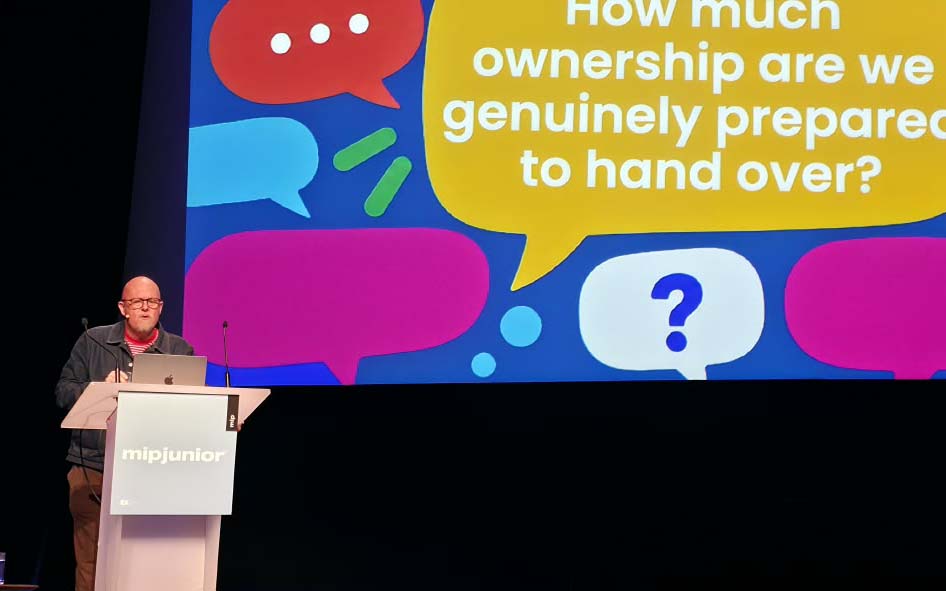
‘Childhood has always been about finding meaning, about discovery, curiosity, and experimentation. It’s about open-endedness. It’s about play’, Pope stated, opening his session titled ‘Beyond Attention: Building Fandom in the Meaning Economy’. He sharply criticized the industry’s reliance on ‘autoplay and addictive features’, citing developmental science to argue that the rapid-fire content often prized by platforms induces a ‘flight or fight stress response’ in young children rather than genuine engagement.
‘The attention economy’s proudest KPI turns out to be a type of flight-or-flight stress response’, Pope noted, declaring that the ‘twenty-year experiment with using children… as advertising inventory, I think, is over’.
To understand what truly drives viewership, Kids Industries surveyed 1,000 children across the UK and the US. The results fundamentally challenge the traditional broadcasting model. When asked why they choose a specific intellectual property (IP), 51% of children cited emotional resonance (‘how it makes me feel’). Furthermore, 28% pointed to the depth of the narrative universe (‘what’s in the world’), and 21% highlighted active participation (‘what it lets me do’). Crucially, when asked why they stay with an IP, participation jumped to 33%, cementing it as a foundational element of long-term engagement.
Pope also used recent global phenomena like K-Pop: Demon Hunters and Wednesday to illustrate that highly specific, emotionally dense, and participatory content ultimately drives massive reach. ‘What the attention economy is being unable to compute is that niche can be input and reach can be output’, he stressed. ‘A property that’s created to have something for everyone will inevitably be generic. It’s infinitely more powerful to make your property mean everything to someone, letting it spread bottom-up so it really does become… for everyone’.
To navigate this reconstituted media landscape, Pope offered attendees five key takeaways for developing successful IPs: Design for meaning before reach: Focus on mattering deeply to a specific audience rather than chasing generic mass appeal. Create distinctive cues: Develop unique aesthetics, movements, and tones that children can decode and use to shape how the content makes them feel. Develop worlds, not just stories: Give audiences lore, secrets, and edges to explore, as deep story worlds consistently beat straightforward plots. Leave space for active participation: Allow the audience to help bring the world to life through interaction, recreation, and sharing. And grow and evolve with the child: Allow characters, narratives, and lore to mature alongside the audience that loves them.
‘They used to say, ‘build it and they will come’, Pope concluded. ‘The trick, as it has always been, is knowing what to build. If we do it with meaning, everything just might be right’.