With that stark warning, Evan Shapiro, the renowned «Media Cartographer,» took the stage for the final keynote of MIP London. His presentation, titled «The Year of Change or Die,» served as a brutal wake-up call to traditional media executives, laying out undeniable data that proves the television business has permanently mutated into a converged ecosystem dominated by Big Tech and the Creator Economy.
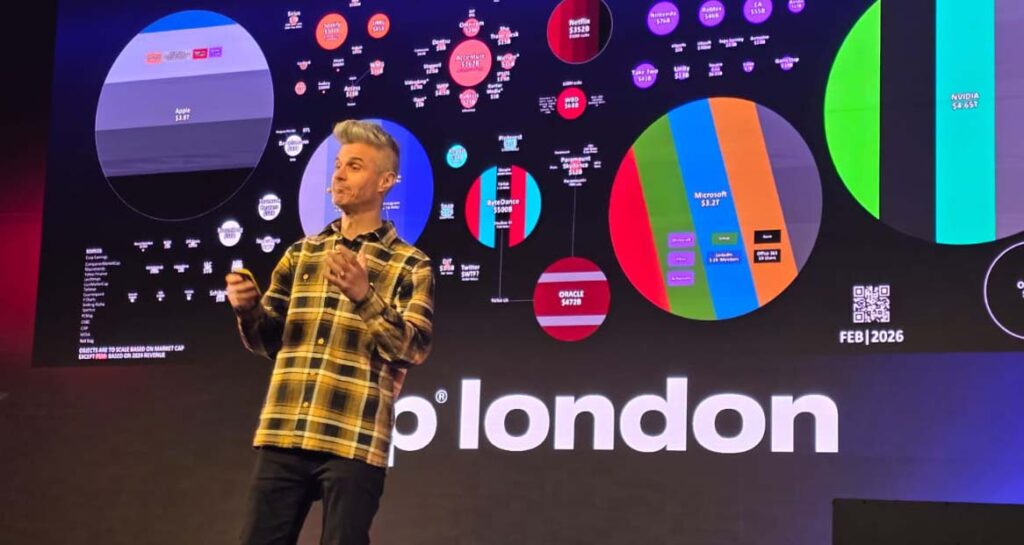
Shapiro opened his session by revisiting his famous «Media Universe Map.» Over the last five years, the narrative has been clear: while traditional media companies have either flatlined (like Disney) or actively disintegrated, Big Tech has doubled, tripled, or even quadrupled in market valuation.
Even streaming pioneers are not immune to the shifting tides. Shapiro pointed to Netflix‘s recent strategy to join traditional media rather than disrupt it—highlighted by its move to acquire Warner Bros. Discovery—as evidence that the original streaming model has plateaued.
The root cause of this massive disruption? A fundamental misunderstanding of demographics. ‘Seventy percent of the world’s population are now Millennials and younger’, Shapiro stated. ‘They grew up with supercomputers in their pocket… The idea that they’re gonna use media in the same way as their parents or their grandparents is just bonkers. They’re not gonna suddenly gain a taste for broadcast like they do beer or coffee’.
The convergence: streaming meets social
For years, the industry believed that streaming would simply act as a faster, digital replacement for linear television. ‘That’s not what happened’, Shapiro corrected. ‘What happened was, as streaming took off, social video took off even faster in a parallel track right alongside it’.
Today, those parallel tracks have merged. Shapiro argued that for Millennials and younger audiences, television has been entirely replaced by a seamless combination of streaming and social media. This convergence is now spilling over to older generations and invading the biggest screen in the house.
The data presented was staggering. In the United States, streaming accounted for 47.5% of all TV viewing last December. But the real shockwave comes from who is leading that charge: YouTube is now the number one channel on American television, larger than all of Disney‘s networks, Paramount, or NBCUniversal.
In the UK, the shift is equally dramatic. Shapiro cited recent BARB data revealing that in Q4 2025, YouTube officially surpassed the BBC in total reach across four screens, and ranked as the number two channel for total share of viewing. Furthermore, 50% of Generation A (Gen Alpha) in the UK watches YouTube on a television set every week, a trend rapidly being adopted by Gen X and Boomers.
‘For the flat earthers out there: the earth is round, water is wet, YouTube is TV. Period’, Shapiro declared to the audience. ‘Can we get over this conversation and move the f*** on?’.
The new ‘affinity economy’
Shapiro stressed that traditional media’s competition is no longer just other broadcasters. Because YouTube acts as an aggregator of 4.6 million active channels, programmers are now competing against ‘eight billion people with a f***ing iPhone’.
This level of fragmentation means that the era of ‘corporate media’ vs. ‘creators’ is a false dichotomy. The real battleground is what Shapiro coined the ‘affinity economy’. In this new merged ecosystem, success is not driven by passive, momentary viewership. It is built on deep engagement, loyalty, and community. ‘It isn’t based on ten seconds of view’, Shapiro explained. ‘Your advertisers want this from you, and this is what you need from your audience too. It’s about building a community, not necessarily an audience’.
A warning for democracy
Shapiro closed his session by elevating the stakes beyond mere entertainment revenue. Pointing to the BBC, he noted that while their iPlayer platform helped mitigate some linear losses, less than half of the British public is now reached by BBC News on television.
He warned that if legacy news and public service broadcasters do not aggressively adapt their distribution strategies to properly serve younger audiences on platforms like YouTube, the consequences will be dire. ‘You wanna know what’s wrong with the world? You wanna know why young people don’t trust traditional news outlets? It’s because we’re not addressing them’.