The global podcasting industry is currently valued at roughly $40 billion and is growing at an astonishing 25% YoY, according to some consultancy companies. Yet, despite these staggering figures and an explosion in consumer listening habits—clocking in at 28 billion hours of audio consumption a year in the UK alone—the industry remains fundamentally ‘underinvested’.
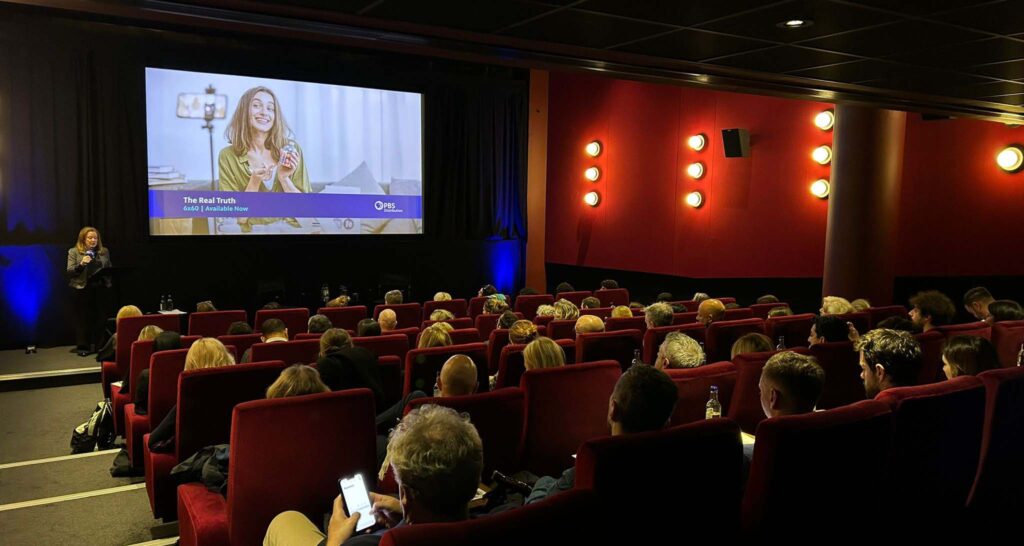
This paradox was the central theme of the «Video Podcasts 2026: Scaling Stories, Maximising Revenue» session held on the final day of MIP London. Moderated by Claire Tavernier, Chair of the Film & TV Charity, the panel brought together leading executives from Podimo, Acast, Patreon, and Little Dot Studios to dissect the shifting economics of digital audio and its rapid pivot to video.
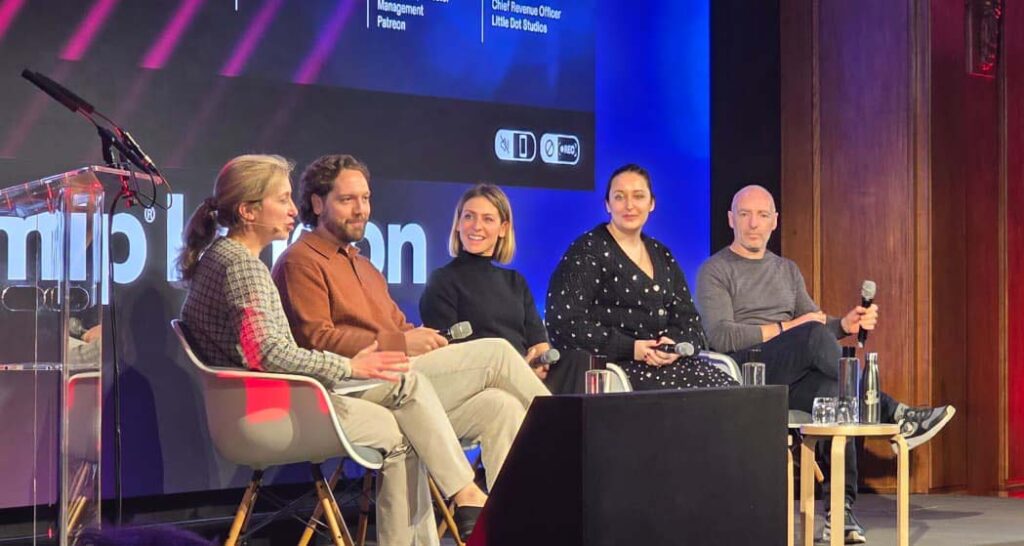
For Georgia Brown, Chief Content Officer at Podimo (and former Amazon Studios executive), the pivot to podcasting was driven by undeniable consumer data. ‘It was really apparent to me a few years ago that there was a big gravitational shift in audience behavior, much like a few years before that when I noticed the shift on the streaming side’, Brown noted.
However, Brown pointed out a glaring discrepancy between audience engagement and financial return. ‘You look at that monetization gap and it doesn’t quite add up. There’s a massive monetization gap in terms of that consumption. How do you monetize that meaningful attention?’.
According to the panel, part of the problem lies with the traditional advertising industry, which Brown described as ‘just not sophisticated enough’ in certain markets to fully grasp the value of digital audio and video, often defaulting to heritage media buying habits.
While traditional advertising catches up, creators are finding massive success through direct-to-fan subscription models. Lina Renzina, Head of Top Creator Management at Patreon, revealed that the platform has paid out over $10 billion to creators over the last 12 years.
To illustrate the sheer scale of the opportunity, Renzina highlighted the case of podcaster Joe Budden, who accidentally leaked his earnings on a live stream last year. ‘He makes a million dollars a month on Patreon’, Renzina confirmed. ‘He has built a robust media company… he has a dedicated audience and following. And to say that you’re making a million dollars a month just through Patreon, ad-free—it has nothing to do with advertising’.
However, the panel cautioned that such success requires treating the podcast as a serious business. Brown noted that the perception of the «creator economy» is often skewed by these massive outliers. ‘The majority of people are not entrepreneurs. They don’t know how to monetize effectively’ she said, stressing the importance of the infrastructure provided by companies like Patreon, Acast, and Little Dot Studios to help creators build sustainable businesses.
Perhaps the most significant evolution discussed was the industry’s decisive shift toward video podcasting, primarily driven by platforms like YouTube and, more recently, Apple.
Josh Woodhouse, Managing Director (UK/IE) for Acast, described the addition of video as a «game-changer» that has «supercharged» the growth sparked during the pandemic. The financial impact is already palpable. ‘We’ve already, at Acast, delivered more booked revenue relating to video-specific formats in 2026 than we did in the entirety of 2025’, Woodhouse revealed.
To capitalize on this, Acast has partnered with Little Dot Studios, a digital content agency known for bridging the gap between legacy media and emerging platforms. Wayne Davison, CRO at Little Dot Studios, explained that they are leveraging their extensive YouTube expertise to help Acast‘s creators optimize their video strategies and drive direct sales revenue.