The economics of live sports broadcasting are undergoing a massive recalibration. With the cost of premium sports rights continuing to skyrocket and consumers globally experiencing acute subscription fatigue, streaming platforms are tearing up the old rulebook to find new ways to engage fans and maximize revenue.
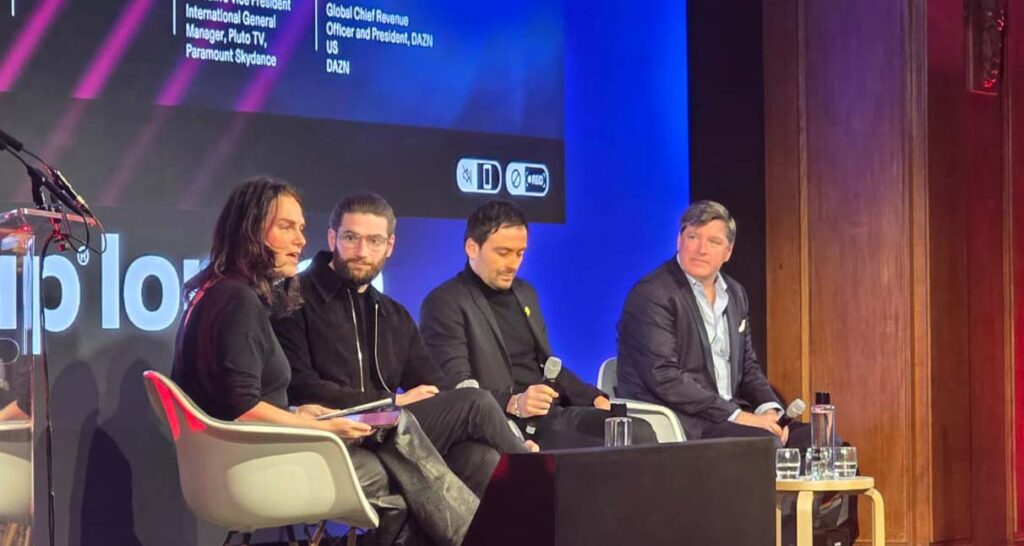
This shifting landscape was the focal point of the «Sport & Creators: Strategic Priorities Shaping Streaming Platforms» session on the final day of MIP London. Moderated by Jennifer Batty, Media Advisor at JJB, the panel brought together heavyweights from across the streaming spectrum: David Salmon, MD International at Tubi; Olivier Jollet, EVP and International General Manager at Pluto TV; and Walker Jacobs, Global Chief Revenue Officer and President of DAZN US.
The economics of Free Sports
One of the most significant shifts in the European market has been the migration of premium sports—once locked exclusively behind paywalls—into FAST environments. DAZN, traditionally a pure-play SVOD service, has recently led this charge through strategic partnerships with platforms like Pluto TV.
For DAZN, the decision to ungate certain live events comes down to a simple, unapologetic metric. ‘The simple answer is economics. It really is as simple as that’, Jacobs admitted.
The exec also explained that unlike traditional broadcasters who buy one or two marquee rights and lock them into prime-time windows, DAZN broadcasts over 110,000 live events annually. By selectively sampling live rights outside the SVOD window, the service can better understand viewership habits without cannibalizing its core subscription base.
For Pluto TV, bringing sports into a FAST environment isn’t about competing with SVODs; it’s about top-of-funnel acquisition. ‘We use sports more as an acquisition driver’, Jollet explained. ‘The free and cheap-only market is now growing faster than the AVOD market… You need to find a new window, new opportunities to reach this younger target group, the hard-to-reach audience’.
Creating cultural relevance
To capture these younger, hard-to-reach demographics, platforms are getting highly creative with how they package sports, leaning heavily into local relevance and creator culture.
Jollet highlighted Pluto TV’s creation of the «Snooker 900» league in the UK. Recognizing that traditional snooker matches could drag on for hours—alienating younger viewers with shorter attention spans—Pluto partnered with legend Ronnie O’Sullivan to create a fast-paced format where games last exactly 900 seconds. In Germany, Pluto TV merged the darts fandom with the Borussia Dortmund football fandom, pitting professional darts players against footballers to create viral, highly engaging social moments.
Tubi is taking a similar approach by blurring the lines between traditional sports broadcasting and creator-led storytelling. Salmon pointed out that fan engagement starts long before the whistle blows. To capture this, The platform leans into deep shoulder programming, such as Naomi Osaka’s documentary The Second Sex and an exclusive podcast with Nick Kyrgios during the Australian Open.
‘There is probably a bit of a false line drawn between traditional creator output and the way that sports personalities now own a connection direct to consumers’, Salmon noted, urging the industry to stop ‘excruciatingly defining’ content and instead focus on maximizing consumer attention.
The monetization challenge
While reach and engagement are growing across FAST and AVOD, the panel acknowledged that monetizing these audiences to their full potential remains a work in progress.
Jacobs offered a candid critique of the ad-supported space: ‘I think their original dream was that the advertising was going to be new pots of money… and I think it’s been underwhelming’. He stressed that while FAST is excellent at programmatic audience buying at scale, the industry has yet to ‘fully unlock’ the bespoke, highly specific ways that sponsors want to activate around particular sports.
Despite these growing pains, the data proves the sheer power of free streaming. Salmon revealed that when Tubi co-distributed the Super Bowl last year, it reached 24 million unique Americans. Crucially for advertisers, the Tubi stream was 38% more likely to reach the coveted 18-to-34 demographic, with more than 50% of the audience being female.
As the panel concluded, Jollet offered a final, emphatic piece of advice to content owners who might still be hesitant about the AVOD space: ‘It is a premium platform. It is premium content… Do I want to put my content on a free platform? The answer is yes. You should’.