As major streaming platforms look to establish or deepen their footprint in competitive international territories, partnering with established telecom operators, pay-TV providers, and even rival streamers to offer combined subscription packages has shifted from a marketing tactic into a core global expansion framework. Faced with subscription fatigue and market saturation, the industry is increasingly utilizing aggregation to navigate complex local infrastructures, lower churn, and capture budget-sensitive audiences.
This strategic shift is mapping out distinctly across different geographic regions. According to research from Ampere Analysis covering 20 major global markets, HBO Max currently leads the streaming bundling landscape with 60 unique partners spanning pay-TV, telcos, and other streaming platforms, featuring in 303 different packages. The regional footprint reveals targeted strategies: while Disney+ drives the most partnerships in North America (52 unique partners globally) and Netflix leads in Western Europe (47 partners), HBO Max’s footprint is heavily concentrated in Central and South America and Central and Eastern Europe (CEE). Notably, 44% of HBO Max’s partnerships take the form of “hard bundles”—packages where the streaming service is a fixed, non-disaggregated component, such as its upcoming integration with Sky Ultimate TV in the UK.
Telecom gatekeepers and the European “frienemy” dynamic
In Europe, telecom operators are aggressively utilizing premium entertainment to differentiate their convergent packages. Vodafone Spain recently intensified this battle by offering customers subscribing to selected fibre and mobile packages access to major streaming platforms—including Netflix, Disney+, and HBO Max—at no additional cost until 2027. This move mirrors strategies from local competitors like Telefónica’s Movistar Plus+, Orange, and MasOrange, which have heavily expanded their entertainment bundles to boost long-term customer loyalty.
Further east, the CEE region presents a unique landscape where global digital trends blend with regional specifics, resulting in a strong “frienemy” relationship between international streamers and local pay-TV operators. While traditional television viewing time has decreased among younger demographics over the past decade, full-scale cord-cutting has not materialized. Pay-TV penetration remains exceptionally high, reaching 90% in Romania and Hungary, and 75% in Poland.
Paradoxically, streaming is actively supporting this legacy broadcast segment. In Romania, 37% of SVOD customers purchase their streaming access directly through their television operators. This centralized purchasing model is particularly popular among the over-55 ‘silver viewer’ demographic, for whom legacy pay-TV serves as a trusted gateway into the broader streaming ecosystem. In this market, platforms like SkyShowtime are capitalizing on cost-conscious bundling, while local players like VOYO and Canal+ Polska fiercely leverage national content quotas to hold their ground alongside global giants.
The platform super-bundle and consumer economics
Beyond telecom partnerships, streamers are increasingly bundling with one another to offer platform-centric aggregation. In the United States, Amazon Prime Video launched a massive five-service streaming bundle combining AMC+, BritBox, MGM+, PBS Masterpiece, and Starz. Priced at $29.99 per month, the package offers a 39% savings compared to individual subscriptions. This intra-platform bundling gives customers an unprecedented breadth of niche and mainstream entertainment at a fraction of the cost, consolidating billing and discovery within the Prime Video interface.
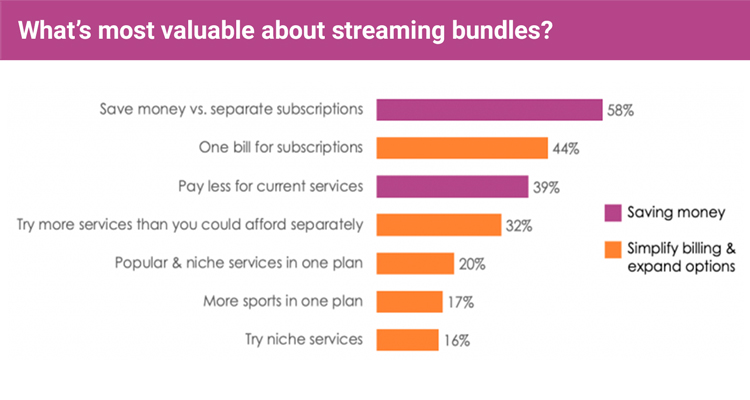
This structural simplicity addresses a major consumer pain point: the economic sustainability of fragmented digital subscriptions. According to the 2026 ‘best bundle’ report by Hub Entertainment Research, financial constraints are now the primary determinant in media consumption. With streamers continuously raising prices, 50% of surveyed consumers strongly agree their available budget is the defining metric when selecting entertainment services, and 44% identify the simplicity of maintaining a single monthly invoice as a primary value driver.
The demand for ‘skinny bundles’ and live TV
Despite the shift to on-demand content, audiences are not entirely abandoning traditional viewing formats; rather, their expectations for how it is packaged are changing. Recent consumer research from Parks Associates, The New Live TV Model: Skinny Bundles, Sports, News, indicates that 51% of US internet households prefer a package that combines live TV with their desired streaming services. Specifically, 27% want a full live-TV bundle combined with streaming, while 24% prefer a ‘skinny bundle’—a cheaper package featuring a limited number of core channels focused on specific content types like sports or news.
Furthermore, 68% of streaming pay-TV subscribers utilizing vMVPD services such as YouTube TV, Hulu + Live TV, Fubo, and DirecTV Stream find the skinny bundle concept appealing. These smaller channel packages act as a middle ground between expensive traditional cable and fragmented streaming-only options.
For media companies, the operational incentives to participate in these consolidated ecosystems are deeply tied to subscriber retention. As noted by Jason Platt Zolov, Senior Consultant at Hub Entertainment Research, studios are highly aware that bundles deliver stronger retention and reduce churn, creating immense incentives to push consumers toward these ‘stickier’ subscription deals. Whether through a telecom operator in Spain, a hard bundle in the UK, or a five-service discount inside Amazon Prime, aggregation has proven to be the definitive route to streaming sustainability.