The phenomenon of Shoppable TV is transforming the relationship between entertainment and commerce on a global scale, with Asia positioning itself as its most advanced and dynamic epicenter. This model, which allows viewers to purchase what they see on screen in real time, has gone from being a technological curiosity to becoming a new consumer standard in markets such as China, South Korea, Japan and India.
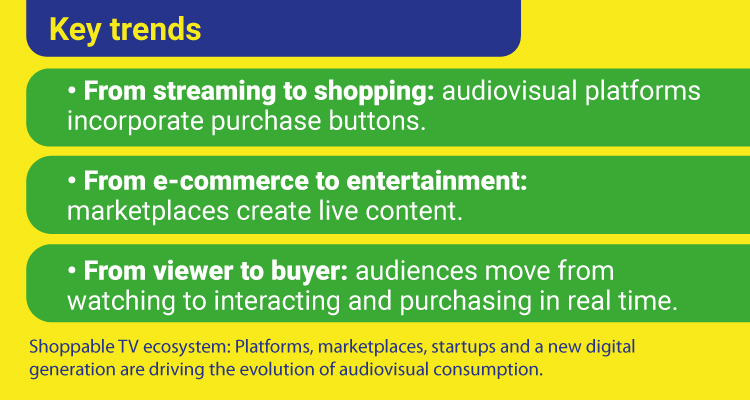
In Asia, the integration of video, technology and retail began much earlier than in the West. China, a pioneer in the segment, has made livestream commerce a pillar of its digital economy. Platforms such as Taobao Live (Alibaba), Douyin (local version of TikTok) and Kuaishou generate billions of dollars in annual sales, combining entertainment, marketing and frictionless commerce. According to iResearch, the value of the Chinese livestream shopping market exceeded £500 billion in 2024 and is expected to reach £700 billion in 2026.
In this context, Shoppable TV is the natural evolution of interactive commerce. Networks such as CCTV and Hunan TV in China, and NHK in Japan, are already experimenting with broadcasts where viewers can scan QR codes in real time to purchase products associated with programmes, series or reality shows. In South Korea, CJ ENM and Naver Shopping Live are leading the hybrid entertainment and sales model, while Samsung and LG smart TVs integrate direct purchase functions from the remote control, facilitating a unified experience.
Technological penetration and the maturity of the digital payment’s ecosystem explain much of Asia’s leadership. Users are accustomed to one-click purchasing through platforms such as WeChat Pay, Alipay, and Paytm, and video has become the preferred format for discovering and deciding on purchases. In addition, the influence of KOLs (Key Opinion Leaders) and influencers boosts user confidence and conversion, creating an emotional connection between content and consumption.
Unlike Latin America, where the model is still in the adoption phase, Asia is already moving towards algorithmic personalization of Shoppable TV. Artificial intelligence analyses viewer behavior to offer contextual products (for example, the clothes worn by the protagonist of a series or the ingredients featured in a cooking programme) in real time. Global brands such as L’Oréal, Nike and Samsung are already using these integrations in regional campaigns.
The cultural impact is also key: in Asia, content consumption is associated with aspiration, community, and convenience. Entertainment commerce is not perceived as invasive advertising, but as a natural extension of digital entertainment. As a result, 70% of Chinese consumers and 50% of South Koreans say they have purchased at least one product during a live broadcast or from a connected screen (according to data from McKinsey Asia 2025).
While Latin America begins to explore the model with initiatives from YouTube and Mercado Libre, Asia is consolidating a mature ecosystem where television, streaming, and commerce converge in a single stream of experience. In the near future, Shoppable TV will not only be a trend, but an essential infrastructure of digital entertainment, with Asia leading the way globally.