Documentaries are no longer just a niche programming option; they are actively dominating the global media landscape. As traditional linear television viewing faces a steady decline, the public’s appetite for authentic, thought-provoking content has intensified. Documentaries have consequently emerged as a primary driver of global media consumption, capturing diverse audiences across streaming platforms, theatrical releases, digital campaigns, and educational institutions alike.
Driving Factors and Market Growth
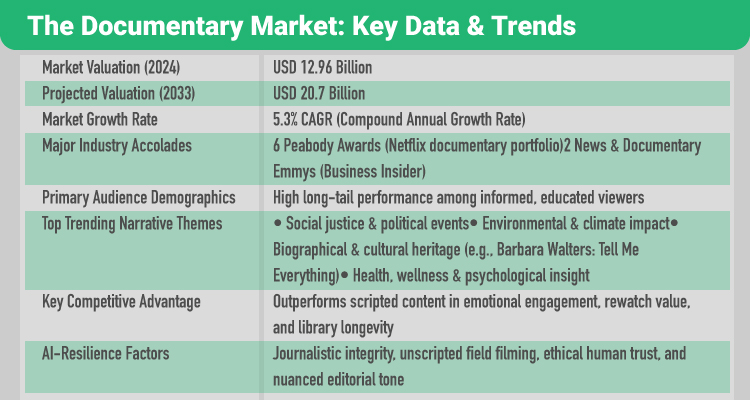
According to market research from Business Research Insights, the global documentary film and television market holds an estimated valuation of USD 12.96 billion. Propelled by shifting viewer habits, the sector is projected to reach USD 20.7 billion by 2033, maintaining a compound annual growth rate (CAGR) of 5.3%.
Industry analysts attribute this rapid expansion to three primary market drivers:
- Viewer Fatigue: Audiences are increasingly fatigued by superficial, fast-entertainment formats, seeking deeper engagement instead.
- Demand for Fact-Based Narrative: There is a growing premium placed on truthful, thoroughly researched, and fact-based storytelling.
- SVoD Investment: Major subscription streaming platforms continue to invest heavily in original non-fiction content as a core retention tool.
The prestige and commercial viability of the genre have been further validated by recent accolades. For instance, Netflix secured six Peabody Awards for its documentary portfolio, while investigative outlets like Business Insider took home two News and Documentary Emmy Awards. In terms of platform performance, non-fiction features are routinely outperforming scripted counterparts in emotional engagement, rewatch value, and long-tail library performance. A prime example is the Netflix docuseries Attack on London: Hunting the 7/7 Bombers, which has drawn massive global viewership and spurred widespread social dialogue.
Streaming, Theatrical Success, and Core Themes
While scripted series struggle to maintain consistent audience numbers, documentaries are expanding their footprint in both streaming and theatrical spaces. In the United Kingdom and Ireland, recent box office statistics indicate that non-fiction titles are performing significantly better in cinemas than projected, driven heavily by investigative, biographical, and nature-focused themes. Even as global platforms diversify into reality television and celebrity-driven filler programming, premium documentary strategy remains a cornerstone for retaining informed, high-value demographics.
The most prominent narrative trends driving consumer demand span several key areas:
- Social Justice & Geopolitics: In-depth explorations of political events and systemic issues.
- Environmental & Climate Impact: High-production films focusing on ecological changes and conservation.
- Biographical & Cultural Heritage: Profiles of prominent figures, such as Barbara Walters: Tell Me Everything, alongside features celebrating traditional crafts and human history.
- Wellness & Psychology: Investigative looks into global health, mental wellness, and psychological behavioral patterns.
The AI-Resistance of Human-Centric Media
While artificial intelligence continues to disrupt workflows and automate processes across various creative sectors, the documentary format remains uniquely resilient to automation. Industry experts emphasize that the fundamental pillars of documentary filmmaking rely on elements that algorithms cannot replicate:
- Ethical Journalism and Trust: Real human stories require cultural context, deep empathy, and the establishment of trust during face-to-face interviews.
- Unscripted Reality: On-the-ground field filming captures raw, spontaneous human moments that cannot be manufactured or modeled by generative software.
- Nuanced Editorial Tone: Compelling emotional arcs demand complex, subtle editing choices and tonal balances that require human lived experience.
- Audience Transparency: The value of a documentary rests on its journalistic integrity and transparency—qualities that AI-generated content inherently lacks.
Strategic Value for Institutional and Brand Commissioners
The shifting media landscape has also changed how corporate brands, government institutions, and non-profit foundations approach media communication. Organizations are increasingly turning away from traditional, short-form advertising in favor of commissioning long-form documentary films.
By utilizing premium non-fiction storytelling, these entities are able to build long-term audience trust, communicate complex organizational missions more effectively than traditional commercial spots, and position themselves as socially responsible leaders while leaving a lasting, measurable emotional impact on viewers.