For years, entertainment executives targeting the MENA have made one fundamental, costly mistake: treating animation as a single, homogenous genre largely meant for children. But as the regional streaming wars intensify, treating a medium as a monolith is leaving money on the table.
Driven by a young, tech-savvy population and a surge in Arabic localization, the wider Middle East and Africa anime market generated a staggering $990 million in 2025. With a projected compound annual growth rate of 13.1% expected through 2033, the race to capture regional audiences is accelerating. However, according to a comprehensive new market analysis by Parrot Analytics, the key to unlocking this billion-dollar expansion lies in abandoning the ‘kids-first’ mindset.
Based on a dataset tracking 5,469 titles across 16 markets during the first quarter of 2026, the Parrot Analytics report reveals that the MENA animation sector is actually four highly distinct economic ecosystems: Kids, Family, Teen, and Adult. Each tier boasts radically different demand patterns, audience profiles, and production origins.
‘Executives who plan against a generic animation average will misread both risk and upside’, the report warns. ‘The better question is not how much animation to buy. It is which audience tier, from which production origin, with what localization and release strategy, can convert unmet audience demand into durable value’.
The adult Whitespace and the Supply Imbalance
The most glaring revelation in the data is a massive supply-and-demand imbalance that strongly favors mature audiences. While streaming libraries are overflowing with children’s content, the real whitespace sits at the top of the age bracket.
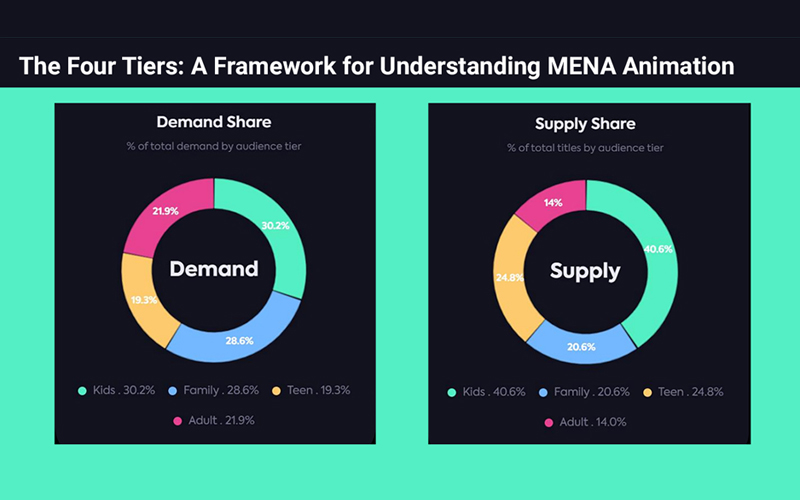
According to Parrot Analytics, adult animation accounts for just 14% of available titles in MENA but commands 21.9% of total audience demand. On a demand-to-supply basis, this means the adult tier’s share of demand is 56% higher than its share of titles. Furthermore, mature animation proves to be the most efficient investment; despite having the smallest catalog footprint, it registers the highest average demand per title (0.363) and the largest share of shows rated ‘Good’ or ‘Outstanding’.
Conversely, the kids’ segment is dangerously oversupplied. It makes up 40.6% of streaming catalogs but captures only 30.2% of demand. The consultancy advises that while children’s content remains a vital anchor—especially for household co-viewing—generic volume is a losing strategy against established juggernauts like PAW Patrol or SpongeBob SquarePants.
The engine of growth: Japanese anime
If adult and teen viewers are driving the region’s animation demand, Japanese anime is the engine powering it.
Anime contributes roughly 39% of all animated demand in MENA, but its dominance skyrockets among older demographics, generating 67% of teen demand and 66.3% of adult demand. In fact, nearly one out of every two animated titles available on MENA streaming services originates from Japan.
Localization is rapidly transforming this content into core regional infrastructure. Crunchyroll, for instance, now offers over 1,300 anime titles in MENA, with more than 1,000 featuring Arabic subtitles and a target to hit 100 Arabic-dubbed titles by the end of 2026. Regional platforms like TOD and Yango Play are also expanding their localized offerings to capitalize on this appetite.
The MENA animation landscape is also essentially a tale of two production giants. The United States and Japan collectively generate over 85% of the region’s animated demand, but they serve entirely opposite halves of the market.
U.S. productions dominate the younger tiers, with 56.1% of American supply rated for kids. Japan is the exact mirror image, with teen and adult content making up nearly 78% of its supply. ‘A strategy built around one production market will leave major audience segments undercovered’, Parrot Analytics notes. The winning formula requires a balanced slate: American family franchises to capture household co-viewing, paired with Japanese IP to hook teens and adults.
Understanding who is actually watching is just as critical. The teen tier is heavily driven by Gen Z (52.4%), proving that for younger viewers, animation is inextricably tied to serialized storytelling and mature themes rather than childhood nostalgia. Meanwhile, the adult animation audience is overwhelmingly male (71.4%), driven heavily by action-packed shōnen properties like Jujutsu Kaisen alongside Western hits like Rick and Morty and Invincible. While this signals a deeply engaged core audience, it also highlights a massive untapped opportunity to introduce broader genres designed to capture female viewership.
The strategy forward
For global media investors and platform executives, the mandate is clear: stop buying animation by the pound.
Parrot Analytics recommends a highly segmented capital-allocation strategy. Streaming platforms must raise the investment threshold for kids’ content—demanding stronger franchise potential—while aggressively increasing their exposure to distinctive adult and family titles.
Furthermore, treating Arabic localization as a long-term strategic capability is no longer optional. As regional production houses like Saudi Arabia’s Manga Productions—which has trained over 4,000 local talents and partnered with Toei Animation—begin to build local IP, the market is poised for a homegrown evolution.