
Live sports programming remains the undisputed anchor of the modern premium video economy. In an increasingly fragmented media landscape characterized by on-demand streaming and algorithmically curated content, live sports is one of the few categories capable of consistently aggregating massive, simultaneous audiences. However, the economic value of sports has grown so significantly—with U.S. media rights projected to exceed $37 billion by 2030—that the systems used to measure these audiences are facing unprecedented scrutiny.
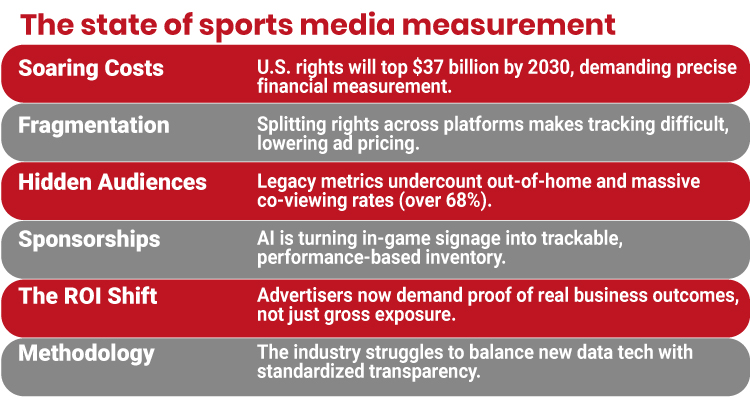
According to a 2026 report by the Coalition for Innovative Media Measurement (CIMM), “Keeping the Score: Industry Perspectives on Innovations in Sports Media Measurement”, audience measurement is no longer just a tool for calculating advertising transactions. Instead, it has evolved into a critical form of market infrastructure that dictates how rights are priced, how streaming platforms compete, and how capital is allocated across the video ecosystem.
The fragmentation challenge
The migration of sports programming across broadcast television, cable networks, direct-to-consumer streaming apps, and social platforms has created a highly complex measurement environment. Stakeholders are currently grappling with severe fragmentation; a single league’s rights can be split across regional sports networks (RSNs), national broadcasters, and streaming platforms, creating significant challenges in producing unified, deduplicated audience metrics.
The CIMM report identifies nine persistent measurement challenges confronting the industry. Chief among these is the difficulty of aggregating viewing in a fragmented ecosystem, alongside measuring second-screen usage, OOH consumption, and the valuation of in-game sponsorships. The lack of unified cross-platform measurement can introduce a ‘fragmentation discount’, wherein uncertainty surrounding total reach and frequency puts downward pressure on advertising pricing.
Furthermore, unauthorized streaming via unlicensed sites and social messaging platforms has emerged as a significant structural hurdle. This piracy shifts a portion of viewing outside measurable environments, complicating audience estimation and potentially distorting the perceived true market value of sports rights.
The economics of attention and co-viewing
The sports media market is undergoing a structural revaluation as advertisers increasingly differentiate between gross audience delivery and the quality of viewer attention. Sports content routinely generates higher attention scores than average streaming programming, driven by the real-time, high-stakes nature of live competition.
Moreover, sports broadcasts exhibit unusually high levels of co-viewing and social consumption. The CIMM report highlights that football broadcasts, for example, can experience co-viewing rates exceeding 68%, outperforming non-sports content. Traditional ratings frameworks, heavily reliant on household-level metrics, often undercount the actual number of individuals watching a game, particularly when consumption occurs out-of-home in bars, restaurants, or workplaces.
Outcomes and sponsorships
Advertisers are demanding more from their high-priced sports inventory. The conversation is rapidly shifting from whether audiences simply saw an advertisement to whether the exposure generated measurable business outcomes. New measurement approaches are integrating exposure data with location analytics, identity-resolution frameworks, and retail transactions to estimate downstream behaviors such as store visits, search activity, and online purchases.
This push for deeper accountability extends to sports sponsorships. Assets like in-stadium signage and digital broadcast overlays were historically evaluated using estimated media value. Today, advances in computer vision and AI are enabling granular, quantifiable tracking of logo visibility, prominence, and duration, transitioning sponsorships from brand-building tools into performance-optimized inventory classes.
Innovation vs. standardization
To address these challenges, the industry is pioneering multi-layered analytical architectures. These emerging solutions include hybrid panel-plus-big-data systems and the integration of platforms’ first-party data into syndicated currencies.
However, as the CIMM report cautions, this innovation comes with profound governance risks. The increasing reliance on proprietary platform data, probabilistic modeling, and clean-room environments raises questions about methodological transparency and competitive neutrality. The ultimate test for the industry will be balancing the rapid pace of technological innovation with the rigorous standardization required to maintain market confidence and comparability across a deeply fragmented global ecosystem.