The war for digital video dominance has entered a new phase. For years, YouTube was the undisputed giant of online audiovisual content, accounting for nearly half of all global interactions. However, the rise of short videos and mobile consumption driven by TikTok has completely changed the landscape. Today, both platforms are competing not only for the public’s attention, but also for advertising revenue and new formats that define the future of entertainment.
In this confrontation, Asia emerges as the most influential battleground. Not only because TikTok was born in China under the umbrella of ByteDance, but also because the continent has the largest volume of active social media users in the world. Countries such as China, South Korea, Japan, Thailand and the Philippines are setting trends in digital consumption and the production of micro-dramas: short stories with a narrative structure, designed to be viewed on mobile phones and during downtime throughout the day.
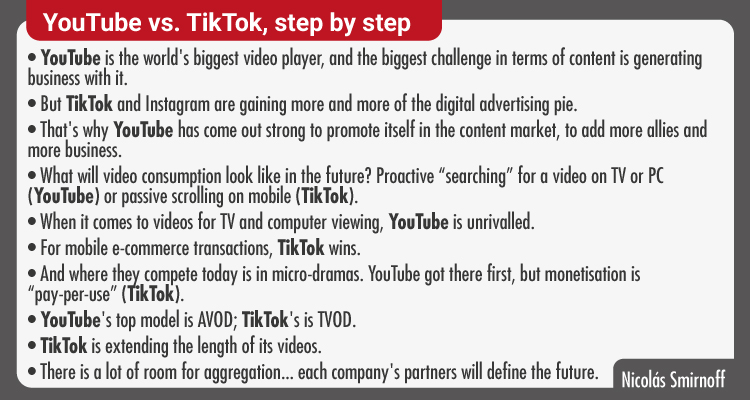
The phenomenon of micro-dramas—lasting between one and three minutes—is now a multi-million-pound industry in Asia. In China, platforms such as Kuaishou and Douyin (the local version of TikTok) already generate more than 25 billion daily views with this type of content, and their business model is based on transactional monetization (TVOD): users pay to watch, unlock episodes or interact with characters. This system is being exported to the rest of the world and represents a direct threat to the AVOD (advertising per view) model that dominates YouTube.
In response, YouTube has set out to strengthen its international presence by participating in events such as MIPCOM Cannes and MIP Cancun, with the aim of attracting producers, creators and commercial partners. It thus seeks to consolidate its leadership in long-form video and expand its YouTube Shorts ecosystem, its direct response to the format popularized by TikTok.
Meanwhile, TikTok is quietly advancing into broader territories, extending the length of its videos and even offering its technology to production companies and IP owners to develop their own applications. Its strategy is not only about content, but also infrastructure.
The battle between YouTube and TikTok is not being fought on a single front: it is being played out on phones, on televisions and, above all, in Asia, where the future of digital video is already underway. In this scenario, micro-dramas are not a passing fad, but the new language of global entertainment.