
One of the top conferences of this year VS Next is OMDIA’ “The Streaming World: business models & trends”, led by María Rua Aguete, senior research director at global media research company, who underlined the main trends on the streaming business: bundling and aggregation, AVOD.
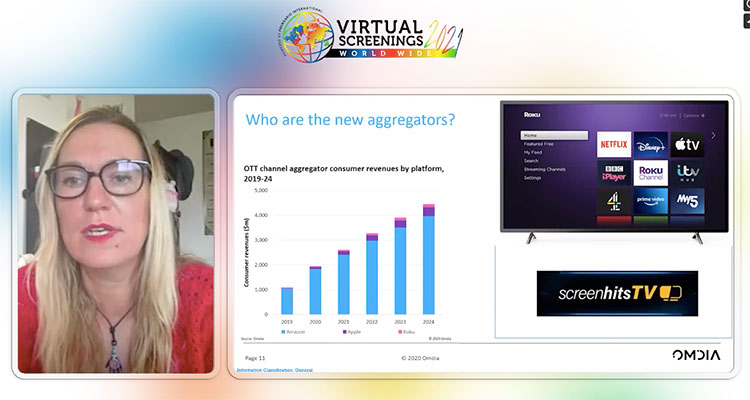
Rua Aguete offered key data & insights and discussed these trends with leading OTT executives. Before the discussion, she described the nowadays industry landscape, highlighting the growth that online video has shown compared to pay TV, but clarified that the latter has maintained and will maintain subscriber stability for 2025: ‘OTTs players will add 500 million new subscriptions in the next five years’.
Regarding advertising, the executive commented that by 2024, online video will have surpassed linear TV in revenues in this sector, being one of the most preferred by advertisers. OMDIA expects revenues to exceed USD 150 billion. About new trends, Rua Aguete mentioned hybridity, where large brands have begun to ally themselves with SVOD and AVOD, or large platforms will offer new forms of subscription. She mentioned platforms with hybrid models like Paramount +, HULU, Star, Crunchyroll, VUDU or Peacock.
Likewise, she said the new business models of the large pay TV operators, who have now become aggregators of services, beyond television, offering music, social networks, solutions for professionals and more. In this section, the executive assured that it will be the most decisive trend so as not to saturate the subscriber market.
David Urgell, SVP head of streaming services EMEA-Asia, ViacomCBS Networks International, referred to the Sky Showtime platform, the OTT resulting from the alliance between Comcast Corporation and ViacomCBS, which will be launched in 2022 in more than 20 European markets covering more 90 million homes, featuring original series from brands including Showtime, Nickelodeon, Paramount Pictures, Sky Studios, Universal Pictures and Peacock. ‘We are basically working on alliances with specific partners to be able to expand our brand in more markets’, he remarked.
Kate Ward, President, Television Division, Vice Studios emphasized that the company’s value is its catalog dedicated to ‘meaningful’ content, which feeds its channels on The Roku Channel and Samsung TV Plus. ‘We were born and we operate in digital, so partnerships with digital players are our natural ways to bring our content’, completed Ward.
Regarding the value of a service provider to sign an alliance with a content producer or distributor player, Adem Uysal, Lead Content Strategy and Acquisition Manager, TV + (Turkey), reported how the service is positioning itself as one of the TV providers most important of Turkey, offering a wide local catalog, as well as a wide variety of American series and animations of houses such as ViacomCBS. ‘Our work is based a lot on what a TV programmer does, and it is in locating the best content for our service, and of course we must stand out from our direct competition: Amazon, Netflix or Disney +, so we identify properties and series that have not been exploited by these services and we acquire them for our market’, he said.
Available in 16 territories in addition to the US, Roku continues to spread to more parts of the world. Yulia Poltorak, Head of International Content Distribution, Roku Inc., commented that Germany was recently added as a new market, where they will explore new co-production business models, with a focus on The Roku Channel and as content aggregators. ‘We work with different business models, although we do not produce, we work very closely with local producers and creators and we offer ourselves to be one more window for their content on our platform. Likewise, we can be the place where a local content platform can be hosted, if your intention is to explore opportunities in foreign markets, such as Globoplay, which is available on our platform in the USA’.
Rose Hulse Adkins, CEO & Founder, ScreenHits TV, concluded that its app comes to help users curate the platforms that exist in the market where it is located: ‘It will be a more growing need in the coming years, when the market is more crowded with OTTs’, she finished.