Driven by rising rights costs and the fragmentation of global audiences, the sports broadcasting industry underwent a structural reorganization in 2025. The sector shifted focus from incremental updates to a fundamental alteration of live delivery architectures, prioritizing cloud-native ecosystems and edge computing over fixed infrastructure. This transition was defined by the consolidation of remote production and the adoption of SaaS-based orchestration, laying the technical groundwork for the integration of immersive formats in 2026.
The function of remote production evolved significantly over the last year. Previously utilized primarily as a budgetary measure to reduce travel and shipping costs, distributed workflows became a standard tool for editorial expansion in 2025.
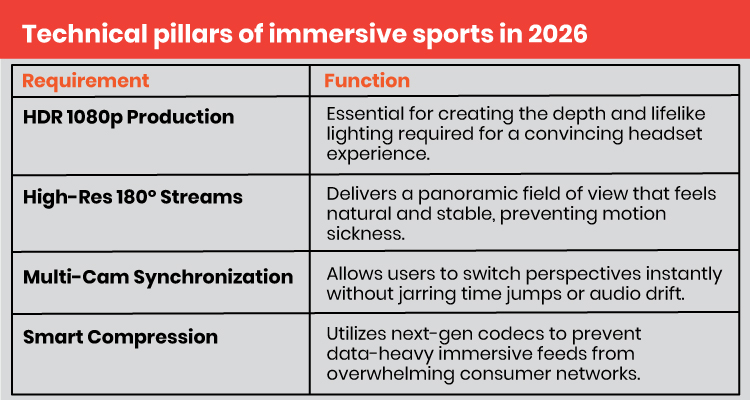
Broadcasters leveraged edge-based contribution technologies to process data locally at venues, ensuring low latency and synchronization. This technical stability allowed production teams to deploy more cameras and specialty angles without the logistical requirements of traditional setups. Consequently, remote production moved beyond efficiency, enabling the creation of denser feeds, including the synchronized multi-camera inputs required for next-generation formats.
Simultaneously, production control moved steadily into the cloud. The industry adopted ‘elastic’ environments where Software-as-a-Service (SaaS) platforms act as the central management system. This allows broadcasters to scale computing power up for high-demand events and scale it back down immediately after the broadcast.
This shift has had tangible operational effects. Cloud-native architectures have facilitated the use of real-time data overlays and dynamic graphics, enabling standard broadcast teams to integrate elements that were previously cost-prohibitive.
Underpinning these changes was a shift in delivery mechanics. As global demand for high-definition streams peaked, broadcasters adopted smarter compression strategies, achieving bitrate reductions of approximately 20% without sacrificing visual quality.
The mainstreaming of the AV1 codec played a central role, offering a device-agnostic solution that allows rights holders to serve diverse global markets efficiently. This «efficiency as strategy» approach is now influencing business models and sustainability reporting, moving engineering decisions into the boardroom.
2026: the immersive horizon
Looking ahead, the infrastructure built in 2025 is set to facilitate the wider adoption of immersive viewing in 2026. With hardware like the Apple Vision Pro and Meta Quest entering the consumer market, the demand for XR sports experiences is moving from experimental to operational.
The report suggests that the coming year will see the introduction of «courtside» 180-degree live streams and spatialized «director’s cuts.» However, these formats place immense strain on bandwidth and synchronization. The industry’s ability to deliver stable, high-resolution 180-degree video and fluid multi-angle switching will depend on the low-latency, cloud-scalable workflows established over the previous year.