
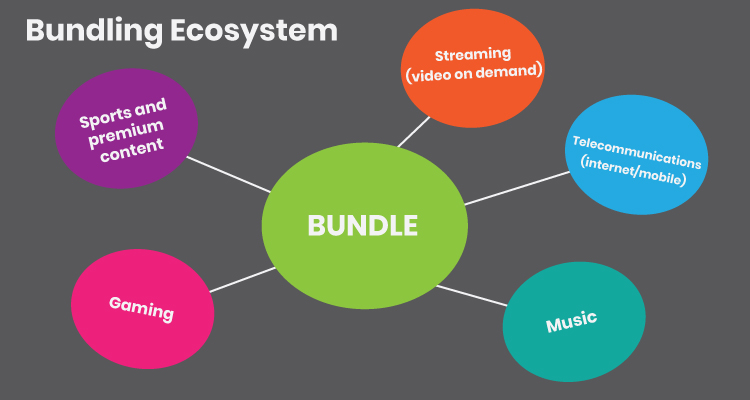
The subscription business is entering a new phase. Although video on demand remains a key driver, growth no longer depends solely on adding platforms, but on integrating them. In this scenario, bundling (offering a range of services under a single plan) is establishing itself as one of the most effective strategies for scaling up, retaining users, and increasing perceived value.
Europe is currently one of the most active laboratories for this model. Operators such as Sky, Vodafone, and Deutsche Telekom have made progress with packages that combine streaming, connectivity, music, and digital services, integrating platforms such as Netflix, Disney+, and Amazon Prime Video into a single bill. In markets such as France and Spain, Canal+ and Telefónica reinforced this logic by adding premium content, sports, and cross-benefits, with the aim of reducing friction and positioning themselves as “the subscription that cannot be canceled.”
The change responds to clear consumer behavior: a preference for simple, flexible, and high-value experiences. More than 60% of global users say they prefer bundles to separate services, and a majority expect brands to collaborate with each other. Bundling is no longer perceived as a rigid package, but as an ecosystem adaptable to the user’s lifestyle.
This approach is also beginning to be replicated outside Europe. In the Middle East, the recent agreement between Shahid, Disney+, and OSN+ marks a regional milestone: a single plan that brings together local content, Hollywood productions, and international titles, with unified billing and a “three for two” value proposition. Although concentrated in the GCC, the model is in line with a global trend.
In the Americas, similar examples can be seen in the United States and Latin America, where telecommunications operators and platforms are seeking to differentiate themselves through strategic alliances. From streaming packages included in mobile plans to combinations that integrate video, music, and gaming, bundling is positioning itself as a direct response to market saturation.
In the subscription economy, growth no longer depends solely on content, but on how each service integrates into a broader ecosystem. For companies, the challenge is clear: stop competing alone and become an indispensable part of the user’s daily life.