The era of relying solely on lucrative first-window deals to sustain a television business is officially over. As the global television industry gathers for the second day of MIP London 2026, the focus has squarely shifted toward maximizing the long-tail value of content across a highly fragmented digital landscape.
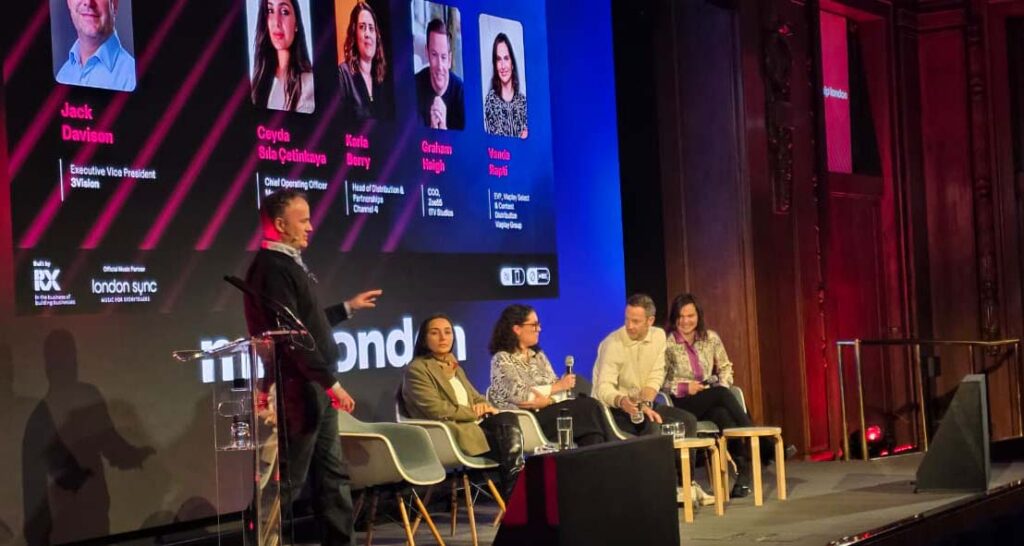
This was the central takeaway from the morning session titled «The New Distribution Playbook: What’s the Deal Now?» Moderated by Jack Davison, EVP of 3Vision, the panel featured key distribution executives who outlined how their companies are completely re-engineering their strategies to survive and thrive in an ecosystem where audiences are scattered across SVOD, AVOD, FAST channels, and social video platforms.
The post-peak TV reality
Davison set the stage with compelling data, illustrating how the distribution market has fundamentally morphed. While the volume of premium scripted content locked behind paywalls has remained relatively stable since 2018 (around 80%), the mechanics underneath have changed drastically. The industry has witnessed the rise and stabilization of studio-owned direct-to-consumer services, followed by a recent aggressive pivot back toward licensing content to third parties and free TV platforms to generate much-needed revenue.
Notably, Davison also highlighted the explosion of ‘box sets’ on free TV platforms. In 2018, only 39% of free TV premieres eventually became available as full box sets; by 2025, that figure skyrocketed to 92%. The traditional linear broadcast is no longer the primary engine—it is merely one layer in a complex distribution stack.
Karla Berry, Head of Distribution & Partnerships at Channel 4, detailed how the UK public service broadcaster is aggressively leaning into this new reality through its ‘Fast Forward Strategy’.
‘More than half of our audience is on Channel 4 via streaming, and so we’re really re-engineering the business leaning into digital first’, Berry explained. This includes heavy investments in their own streaming app, the joint PSV launch of Freely (the fastest-growing TV platform in the UK last year), and groundbreaking experiments with platforms like Spotify, where they are testing video content beyond traditional podcasts.
Channel 4 has also found massive success by embracing YouTube. ‘Our full episodes were up 55% last year, and we reached 175 million views’, Berry noted. By utilizing a specialized digital studio team in Leeds, the broadcaster is learning how to optimize windowing, metadata, and packaging for platforms like Instagram and TikTok, while ensuring their owned-and-operated app remains the primary destination for data collection and brand control.
For Graham Haigh, COO of Zoo 55 at ITV Studios, the mandate is clear: hit a £120 million revenue target next year. To achieve this, ITV Studios is looking past traditional licensing and heavily mining its deep library of content.
‘We built the Zoo business purely on the archive and the library’, Haigh stated, citing shows that are 10 to 25 years old, like The Voice or River Monsters. By applying a strict, data-led lens to distribution, ITV is able to identify highly ‘clickable’ moments within older shows and repackage them for YouTube and other social video platforms, effectively creating ‘net new content’ for massive global audiences.
Davison echoed this sentiment, noting that during the height of Peak TV, the ultimate financial value of a show was extracted almost entirely in its first window. Today, distributors must work tirelessly to extract value over time, placing content in different environments at different stages of its lifecycle.
Navigating this complex web of social video and AVOD platforms requires specialized expertise, leading to the rise of companies like Merzigo. Ceyda Sıla Çetinkaya, CCO at Merzigo, explained that their agency steps in to handle everything from launching a company’s initial YouTube and Facebook strategies to optimizing existing, underperforming channels for major distributors.
Ultimately, the new distribution playbook discussed at MIP London 2026 demands a dual approach: broadcasters must aggressively protect and grow their owned-and-operated digital destinations while simultaneously exploiting every available third-party platform—from FAST channels to YouTube—using deep data analytics to squeeze every last drop of value out of their content libraries.