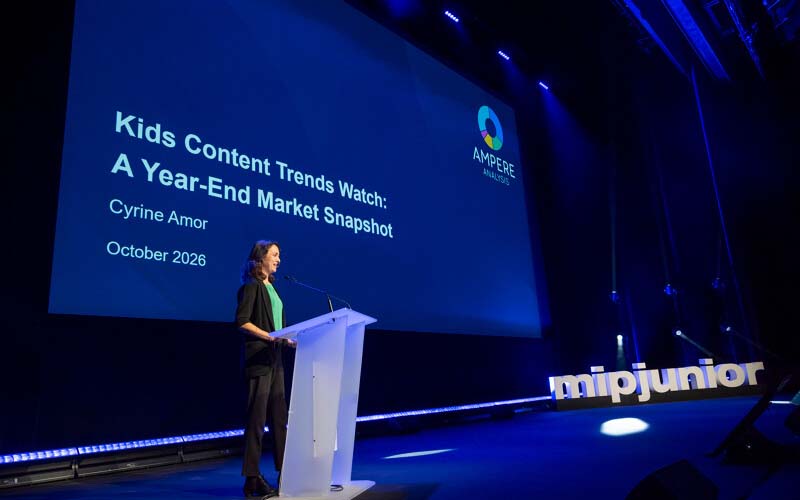
Cyrine Amor, Senior Research Manager at Ampere Analysis, delivered a sobering snapshot of the industry, revealing a dramatic contraction in streaming commissions. Once viewed as the ultimate sanctuary for kids’ programming due to high repeat-viewing habits, SVOD platforms have drastically reduced their first-run orders. According to the presentation, global SVOD kids’ TV commissions plummeted from 196 in the 12 months leading to the first half of 2022, down to just 88 in the same period for 2026. While this represents a 22% recovery from a low of 72 orders in 2025, it reflects a radically diminished marketplace.
This pullback is largely driven by a fiercely fragmented competitive landscape. SVOD operators collectively offer 240,000 hours of annual global content, with Netflix contributing 4,000 hours. However, AVOD services now provide a massive 140,000 hours worldwide, led by platforms like Tubi with 24,000 hours. The most formidable rival remains YouTube, boasting 250 massive kids’ channels—80% of which target preschoolers—that collectively deliver 300,000 hours of video content across traditional uploads, shorts, and livestreams.
Furthermore, streaming platforms have recognized that audiences heavily favor legacy titles over fresh releases. Citing PlumResearch data, the presentation highlighted that long-tail catalog viewing accounts for an overwhelming 90% of consumption and 75% of active titles. Viewers are reliably gravitating toward established library hits such as Star Trek, Dark, Archer, and Primal rather than exclusively chasing new, high-risk blockbusters like Squid Game. Consequently, the share of «new content» (released within the last five years) has halved on Amazon Prime Video from 22% in July 2022 to 11% in July 2024, and dropped from 23% to 13% on Disney during the same period. Even Netflix, known for aggressive commissioning, saw its new content share fall from 48% to 36%.
Compounding the challenge for streamers is the behavioral shift of Generation Alpha. Unlike Gen Z, who primarily turn to streaming services to relieve boredom or seek immersion, children born in the 2010s and early 2020s are exhibiting entirely different media habits. When Gen Alpha wants to be immersed or simply take their minds off things, they overwhelmingly choose video games and gaming apps as their first resort, bypassing both traditional streaming and YouTube.
With private-sector streamers tightening their belts, the burden of funding new, educational children’s media falls heavily on public service broadcasters (PSBs) like the BBC and Germany’s ARD. Together, PSBs stand as the largest remaining pillar for original kids’ content, generating 371 commissions in the 12 months prior to mid-2026. As media analyst Evan Shapiro—who will deliver the market’s closing keynote on October 11—previously noted, these institutions «should be cherished.»
Yet, the financial reality for these networks is increasingly grim. Amor cautioned that PSB revenues have plateaued at an estimated $53 billion for 2026, a figure utterly dwarfed by the $174 billion generated by subscription OTT platforms and $292 billion from online advertising. Factoring in a 3.8% inflation rate across the EU, the actual spending power of public broadcasters is actively shrinking, leaving kids’ content highly vulnerable to future budget cuts.