Following the success of the Country of Honor initiative, the Japanese audiovisual industry consolidates a public-private strategy to export intellectual property and attract international investment.
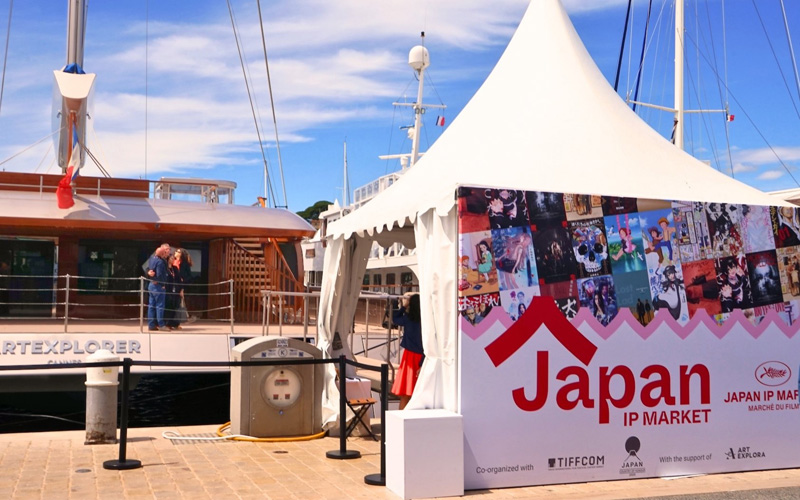
The Marché du Film (Festival de Cannes) and TIFFCOM will co-organize the Japan IP Market for a second consecutive year, scheduled for May 14 to 15, 2027. The announcement, made during the “Beyond Country of Honor” panel at TIFFCOM 2026, marks a strategic shift for the Japanese audiovisual sector: moving from traditional finished-content sales to early-stage intellectual property (IP) development and international co-production.
Launched in 2026 as part of Japan’s Country of Honor activities at Cannes, the initiative connected rights holders like Kadokawa, Shochiku, and Toei with global professionals through targeted meetings and pitch sessions. “The success of Japan showed what can happen when a focused national presence creates lasting opportunities. The Japan IP Market is one of those outcomes, giving Japanese intellectual properties greater access to international partners,” stated Guillaume Esmiol, Executive Director of the Marché du Film.
Alexandra Zakharchenko, Head of Industry Programs at the Marché du Film, added that the goal is to build on this momentum. “By bringing them together in Cannes, we can help turn growing interest in Japanese content into concrete adaptation deals and acquisitions, while fostering new collaboration opportunities,” she explained.
During the TIFFCOM panel, industry executives analyzed how the Cannes strategy has evolved. Ushio Komatsu of Toho Global explained that, historically, Japanese companies attended markets primarily as sellers, with a booth or to acquire foreign video rights. “Now, the focus is on what we can appeal to as a country, bringing classic works and pushing for co-productions. Producers are attending to pitch their own projects and find partners, which is a completely new movement for us,” Komatsu noted.
This structural shift is allowing emerging studios and younger producers to access the global market earlier in the production chain. A representative from K-Pictures highlighted the value of initiatives like the Producers Network at Cannes. “Pitching a project first means that the people who approach you afterward already know who you are and what you offer. It creates highly meaningful meetings with professionals genuinely interested in international co-production, rather than having to explain everything from scratch,” she detailed.
The scale of Japan’s 2026 deployment was unprecedented, driven by strong governmental backing. Veteran producer Takeo Hisamatsu compared this momentum to Latin America’s past efforts to penetrate the European market. “Twenty-five years ago, Brazil went to Cannes with huge investment, but I didn’t feel a unified public-private effort. Seeing Japan in 2026, with the government stepping up and the CEOs of the major studios personally attending, was massive. It is no longer just about acquiring content; it is a place for creators, studios, and production companies to build together.”
The Country of Honor initiative also repositioned Japanese animation within the traditional film market. Historically, the anime industry focused heavily on specialized festivals like Annecy. However, the panel highlighted that leveraging the Marché du Film acts as a crucial stepping stone. Gaining recognition and networking at Cannes creates a stronger foundation for animated IPs before they transition to animation-specific global circuits.
The primary challenge discussed at TIFFCOM is maintaining this business momentum in 2027 without the exclusive “Country of Honor” spotlight. Hisamatsu stressed the necessity of maintaining a physical hub for networking. “We absolutely need a place where Japanese professionals can gather, share information, and meet international partners. The Japan Pavilion must continue to serve as that base to ensure this becomes a lasting legacy,” he urged.
Affirming this long-term vision, Hiroshi Oohiro, Director of the Cultural and Creative Industries Division at the Ministry of Economy, Trade and Industry (METI), closed the session by classifying content as one of Japan’s top strategic sectors, second only to AI in economic ripple effects. “The most important thing is that this is not a one-time event, but a continuous effort. As a government, our role is to back this up, and we intend to continue supporting these established relationships to deliver Japanese content to the world,” Oohiro concluded.